
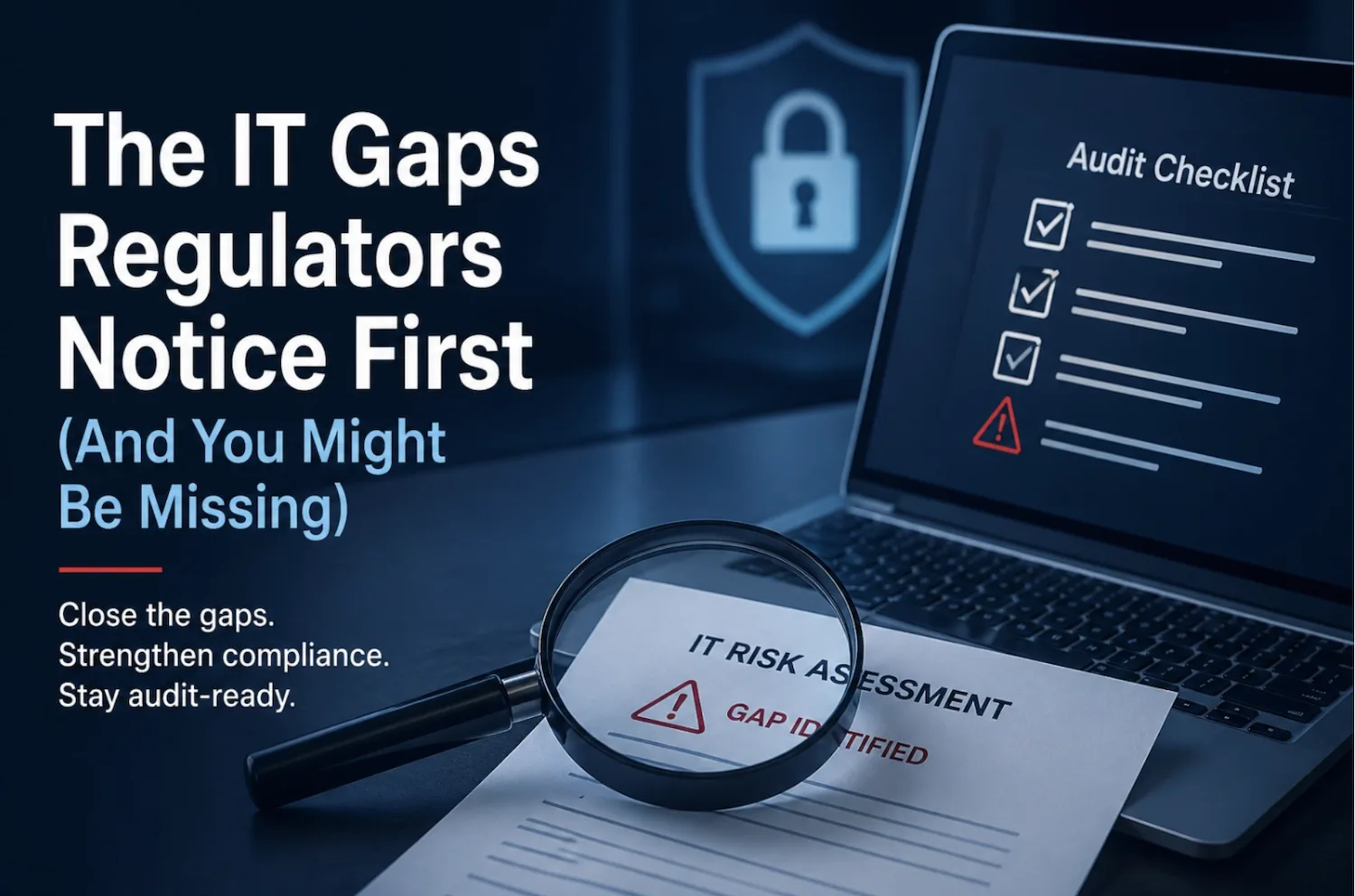
The Audit That Starts Before You’re Ready
Most organizations think audits begin when the auditor walks in.
In reality, they start much earlier—within your systems, your logs, your documentation, and your daily operations. By the time someone asks for evidence, the story has already been written.
For community banks, credit unions, and healthcare organizations, this creates a dangerous blind spot. You may feel prepared, but regulators aren’t evaluating intent. They’re evaluating consistency.
And the gaps they find first are rarely the ones leadership expects.
The Core Problem: Assumed Coverage vs. Proven Control
Many organizations believe their IT environment is “covered.”
You have endpoint protection. Backups are in place. Patching happens. Your internal team is doing everything they can.
But regulators don’t ask if something exists… they ask if it’s consistently enforced, monitored, and documented.
This is where exposure begins.
A bank may have security tools deployed across most systems, but if even a small percentage fall outside policy, that becomes a finding. Not because the control doesn’t exist—but because it isn’t consistently applied.
Want a clear breakdown of how auditors evaluate environments?
Why These Gaps Carry More Risk Today
Compliance expectations have shifted.
Regulators now expect continuous control—not point-in-time fixes. That means your organization must demonstrate that monitoring, patching, access control, and recovery are happening consistently—not just before an audit.
Consider a real scenario:
A credit union passes its annual audit. Months later, a ransomware incident reveals delayed patching and missed alerts. The issue isn’t just the attack—it’s the failure to detect and respond earlier.
Now leadership is explaining not only what happened—but why the controls didn’t work.
The Gaps That Surface First
Across audits, the same issues tend to appear first—not because they’re complex, but because they’re foundational.
Access control is one of the biggest. Users accumulate permissions over time, and without structured reviews, access quickly becomes excessive or outdated.
Documentation is another major gap. Even if your team is doing the right things, if policies, logs, and procedures aren’t documented, they don’t count.
This is why documentation plays such a critical role in compliance.
Patch management is also a common issue. Delays—even small ones—create exposure, especially when tied to known vulnerabilities.
And then there’s backup and recovery.
Many organizations have backups. Far fewer test them.
The Real Issue: Lack of Visibility
At the root of these problems is visibility.
Leadership often doesn’t have a clear picture of what’s happening inside the IT environment. Internal teams are juggling priorities, and without centralized reporting or monitoring, small issues go unnoticed until they become findings.
This creates a reactive cycle—one that doesn’t hold up under regulatory scrutiny.
Moving From Activity to Accountability
Closing these gaps isn’t about adding more tools.
It’s about ensuring the tools you already have are consistently used, monitored, and documented.
Organizations that improve audit outcomes focus on:
- Continuous monitoring instead of periodic checks
- Documented processes instead of informal workflows
- Regular testing instead of assumptions
- Clear ownership instead of shared responsibility
If your environment still feels reactive, this may sound familiar.
What Better Looks Like
Strong organizations don’t necessarily have more resources.
They have more structure.
A healthcare provider that struggled with inconsistent patching implemented centralized automation and reporting. Within months, they moved from uncertainty to full visibility.
A financial institution standardized access reviews and eliminated audit findings tied to user permissions.
These aren’t massive overhauls. They’re focused on improvements in consistency.
The Takeaway
Compliance isn’t something you prepare for. It’s something you operate within.
When you can clearly answer who has access, what’s being monitored, when updates occur, and how quickly you can recover, audits become validation—not disruption.
0 Comments