
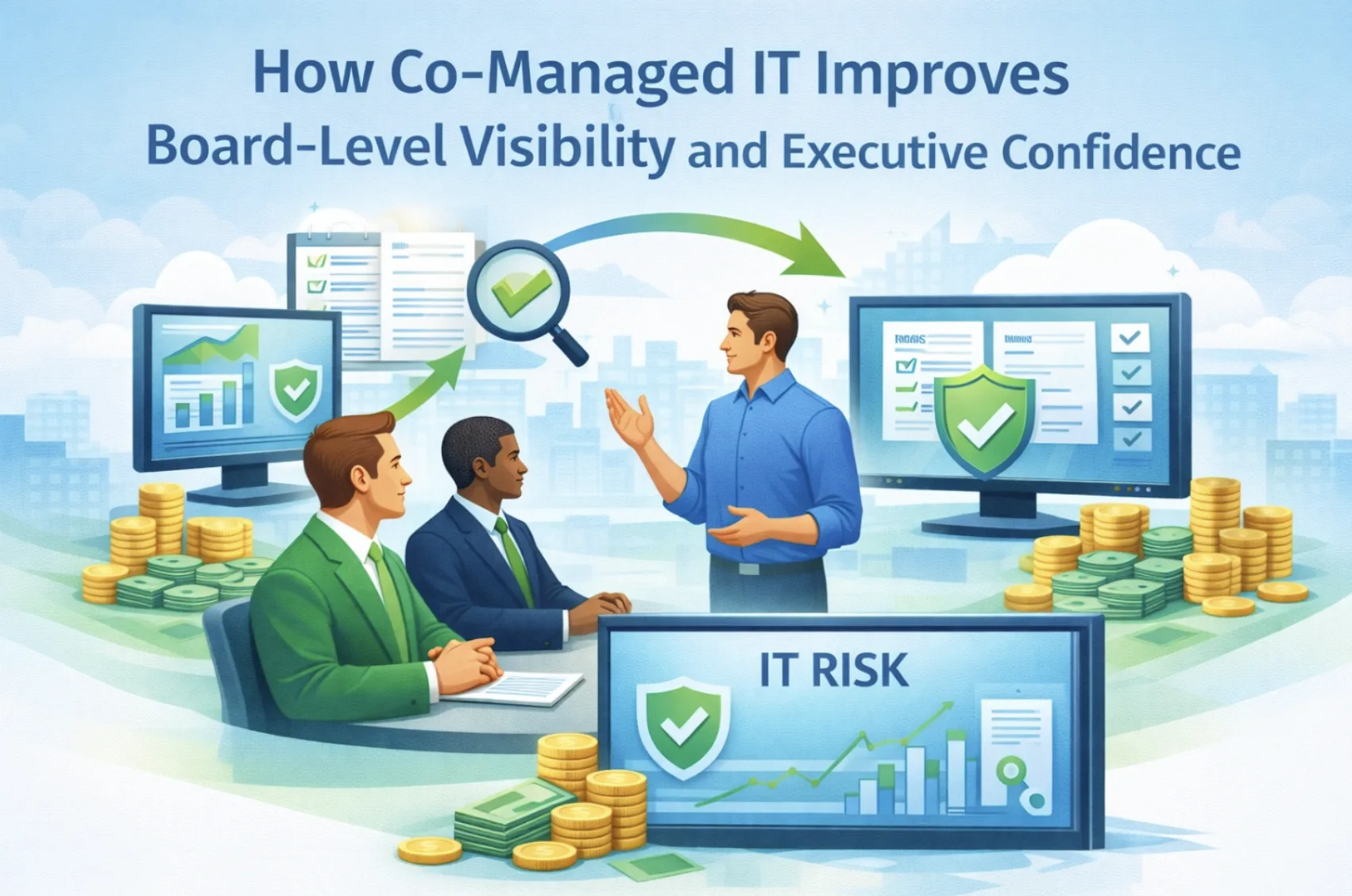
It is a board-level concern.
Directors and executive leadership increasingly ask questions like:
- Are we protected from cyber threats?
- How do we know our controls are working?
- Are we prepared for an audit or exam?
- What would happen if we experienced a breach?
- Is our IT team properly resourced?
These are not technical questions. They are governance, risk, and fiduciary responsibility questions.
For many organizations, the challenge isn’t that IT is unmanaged — it’s that visibility into IT risk and performance is limited at the executive level.
Co-managed IT helps bridge that gap.
The Growing Governance Responsibility Around IT
Boards and executive teams are being held accountable for:
- Cybersecurity oversight
- Regulatory compliance
- Operational resilience
- Third-party risk
- Incident response readiness
Regulators increasingly expect leadership to demonstrate not just awareness of IT risks — but active oversight.
This expectation aligns with the themes we discussed in March’s post on what regulators and auditors expect from your IT.
But here’s the challenge:
Most board members are not IT professionals.
They need clarity — not technical jargon.
The Visibility Gap Many Organizations Face
In many regulated organizations, IT reporting is informal or inconsistent.
Common issues include:
- Reports filled with technical details but lacking business context
- No clear metrics tied to risk
- Limited documentation of monitoring or remediation efforts
- Inconsistent audit preparation
- Difficulty answering board-level questions confidently
Internal IT teams may be doing strong work — but leadership doesn’t always have structured visibility into that work.
This creates uncertainty at the executive level.
How Co-Managed IT Improves Visibility
Co-managed IT strengthens governance by introducing structured reporting, monitoring, and documentation practices.
Let’s break that down.
1. Consistent Reporting and Metrics
Co-managed IT environments often include regular reporting on:
- System health and uptime
- Security monitoring activity
- Patch compliance status
- Backup verification results
- Risk assessment findings
- Incident response summaries
Instead of vague updates, leadership receives measurable insights.
This allows executives to answer questions like:
“How do we know we’re protected?”
With confidence.
Want clearer visibility into your IT risk posture?
2. Clear Documentation for Oversight
As we discussed in March’s blog on IT documentation as a compliance cornerstone, documentation is essential — not just for auditors, but for leadership.
Co-managed IT helps ensure:
- Policies stay current
- Controls are documented
- Evidence is centralized
- Processes are repeatable
This improves transparency and reduces uncertainty during exams or board reviews.
3. Defined Roles and Accountability
One of the biggest governance risks is unclear responsibility.
Co-managed IT clearly defines:
- What internal IT owns
- What the external partner manages
- How escalations are handled
- Who communicates incidents
This structure improves accountability — something boards increasingly expect to see.
4. Stronger Risk Communication
Cybersecurity discussions often fail at the executive level because they are too technical.
Co-managed IT helps translate:
From:
- “We deployed endpoint detection updates.”
To:
- “We reduced exposure to ransomware risk by addressing identified vulnerabilities.”
This aligns IT conversations with business outcomes.
It also reinforces the importance of proactive risk assessments discussed in why risk assessments are no longer optional for regulated organizations.
5. Reduced Reliance on a Single IT Leader
Many organizations depend heavily on one internal IT manager.
While capable, that structure can create governance risk:
- Limited reporting structure
- Single point of knowledge
- No redundancy
- Increased burnout risk
Co-managed IT distributes oversight and strengthens documentation, reducing executive concern about continuity.
Real-World Example
A regional financial institution’s board began requesting more formal cybersecurity reporting following regulatory guidance updates.
The internal IT team was capable, but reporting was informal and reactive.
After implementing a co-managed IT model, the organization introduced:
- Structured monthly IT performance reports
- Documented patch compliance metrics
- Security monitoring summaries
- Clear escalation documentation
Board members reported increased confidence in oversight. Audit discussions became smoother. Executive leadership felt better prepared to answer regulator questions.
Control remained internal — but visibility improved significantly.
Why This Matters to Executive Leadership
From a leadership standpoint, the goal isn’t technical perfection.
It’s confidence.
Confidence that:
- IT risks are understood
- Controls are functioning
- Documentation is current
- Compliance obligations are met
- Incidents will be managed effectively
Co-managed IT strengthens that confidence by formalizing monitoring, reporting, and accountability structures.
It builds on the operational support we outlined throughout April — but elevates it to the governance level.
Frequently Asked Questions
Does co-managed IT replace executive oversight?
Will board reporting become overly technical?
Does this help during regulatory exams?
Is this only necessary for large institutions?
Final Thought
In regulated environments, IT is no longer just a support function — it’s a governance priority.
Boards and executives need more than assurances. They need visibility, structure, and confidence.
Co-managed IT provides that balance:
- Preserving internal control
- Strengthening security
- Improving documentation
- Enhancing reporting
- Reducing executive uncertainty
It turns IT from a potential blind spot into a strategic asset.
0 Comments