
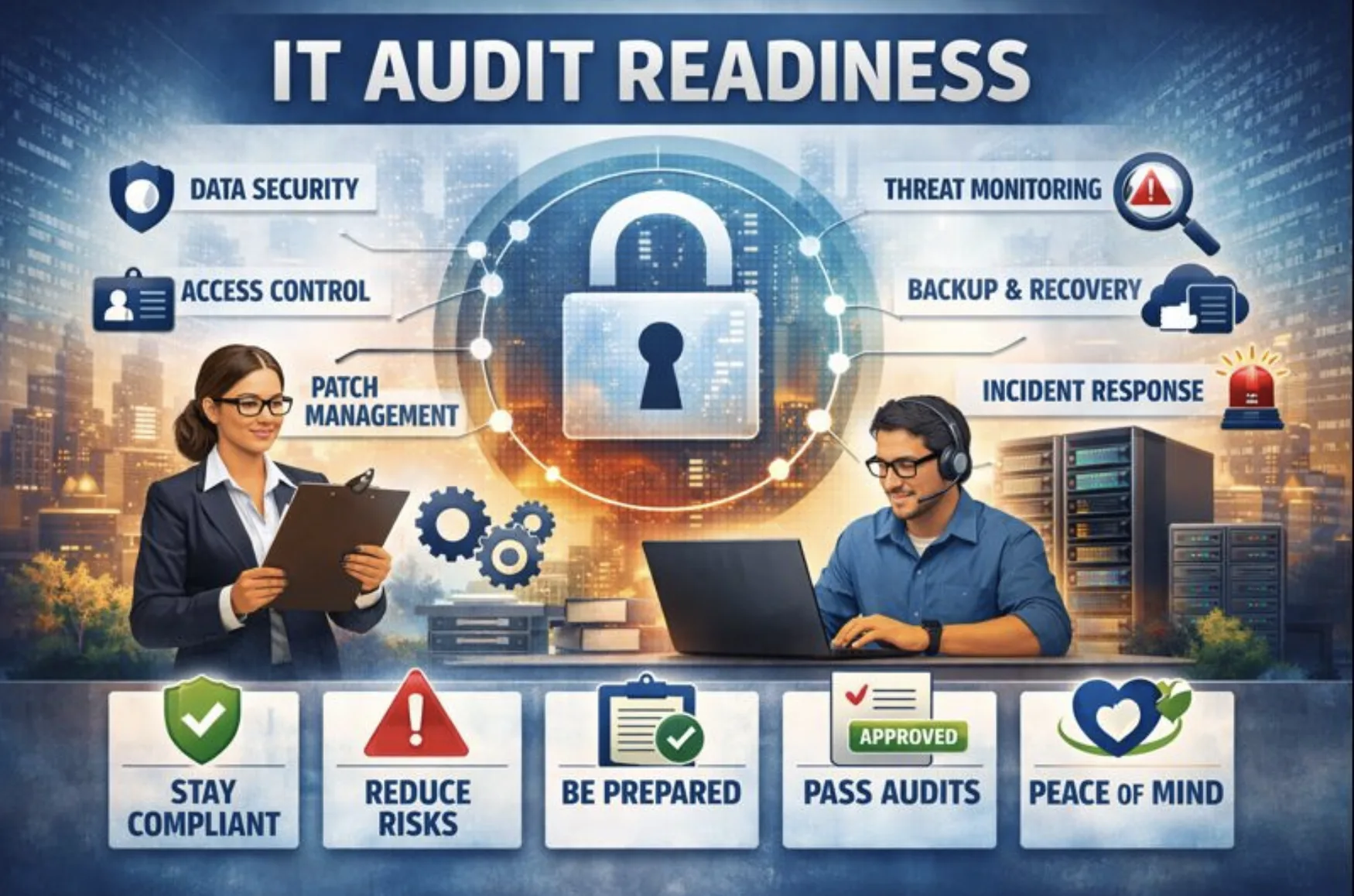
Whether you’re a bank, credit union, healthcare organization, or another business handling sensitive data, regulators and auditors are paying closer attention to IT than ever before. Technology is no longer viewed as a “back-office function.” It’s now considered a core component of risk management, compliance, and operational resilience.
The good news? Most audit findings aren’t the result of malicious intent or negligence. They happen because organizations don’t fully understand what regulators expect from their IT environment—or how to prepare consistently.
Let’s break it down in clear, practical terms.
Why IT Is Now Central to Audits and Exams
Regulators and auditors care about one primary question:
Can this organization protect sensitive data and continue operating reliably—even when something goes wrong?
IT touches every part of that question.
Modern audits now focus heavily on:
- Data security
- System availability
- Access controls
- Monitoring and incident response
- Documentation and evidence
This shift mirrors what we discussed earlier in our February pillar on what managed IT services really include—IT today is about prevention, visibility, and accountability, not just fixing problems.
The Core IT Areas Regulators and Auditors Review
While specific regulations vary by industry, most audits and exams evaluate the same foundational IT control areas.
1. Access Control and User Management
Auditors want to know:
- Who has access to what systems?
- Is access appropriate for each role?
- Are accounts removed promptly when employees leave?
Weak access controls remain one of the most common audit findings, especially when passwords are reused or multi-factor authentication isn’t enforced. If this sounds familiar, our January post on why passwords alone aren’t enough provides helpful context.
Unsure who has access to your systems today?
2. Security Monitoring and Threat Detection
It’s no longer enough to say, “We have antivirus.”
Auditors increasingly expect:
- Continuous monitoring
- Alerts for suspicious activity
- Evidence that alerts are reviewed and acted upon
This aligns closely with the layered security approach covered in our January blog on what layered security actually means.
The key expectation here is visibility. Organizations must demonstrate they are actively watching their environment—not discovering issues after damage has occurred.
3. Patch Management and System Updates
Unpatched systems are one of the most common—and avoidable—risks in regulated environments.
Auditors often ask:
- How do you ensure systems stay updated?
- How often are patches applied?
- Is this process documented?
This is an area where reactive, break-fix IT frequently falls short, as discussed in our February blog on outgrowing break-fix IT support.
4. Backup, Recovery, and Business Continuity
Backups are only valuable if:
- They run consistently
- Someone verifies them
- Recovery procedures are tested
Auditors typically look for:
- Backup schedules
- Verification reports
- Recovery plans
- Evidence of testing
This is also where downtime risk becomes a compliance issue, not just an operational one—something we explore further in the hidden costs of downtime.
Not sure your backups would hold up in an audit?
Talk to an IT specialist about backup and recovery readiness.
5. Incident Response and Escalation
Organizations are expected to have a plan—not just hope—for security incidents.
Auditors may ask:
- How do you detect incidents?
- Who is notified?
- How are incidents documented?
- How do you prevent repeat issues?
Even if you’ve never experienced a breach, having a documented incident response plan is often a requirement.
Why “We Outsource IT” Is Not Enough
One common misconception is that outsourcing IT automatically satisfies regulatory expectations.
Regulators expect accountability, not delegation.
Even when working with a managed IT provider:
- You are still responsible for compliance
- You must understand your controls
- You must be able to produce documentation
The difference is that a strong managed IT partner helps you maintain, document, and demonstrate compliance—rather than leaving you to figure it out alone.
How Managed IT Supports Audit and Exam Readiness
Managed IT services help regulated organizations prepare by providing:
- Proactive monitoring and maintenance
- Consistent security controls
- Documented processes and procedures
- Regular reporting and visibility
- Support during audits and exams
This proactive model aligns IT operations with regulatory expectations—reducing last-minute scrambling and surprise findings.
Real-World Example
A regulated financial organization entered an exam confident in their IT environment but quickly encountered challenges when asked to produce documentation related to patching, access control, and monitoring.
While systems were generally secure, processes weren’t consistently documented.
After transitioning to managed IT services, the organization gained:
- Standardized documentation
- Ongoing monitoring reports
- Clear access control policies
- Greater confidence during future exams
The result wasn’t just fewer findings—it was less stress for leadership and IT staff alike.
Frequently Asked Questions
Do regulators expect perfect IT environments?
Can managed IT replace internal compliance responsibilities?
Is audit preparation only necessary right before an exam?
Does this apply outside of banking and healthcare?
Final Thought
Regulators and auditors aren’t looking for perfection; they’re looking for preparedness, visibility, and accountability.
When IT is proactive, documented, and well-managed, audits become far less disruptive and far more predictable.
0 Comments