
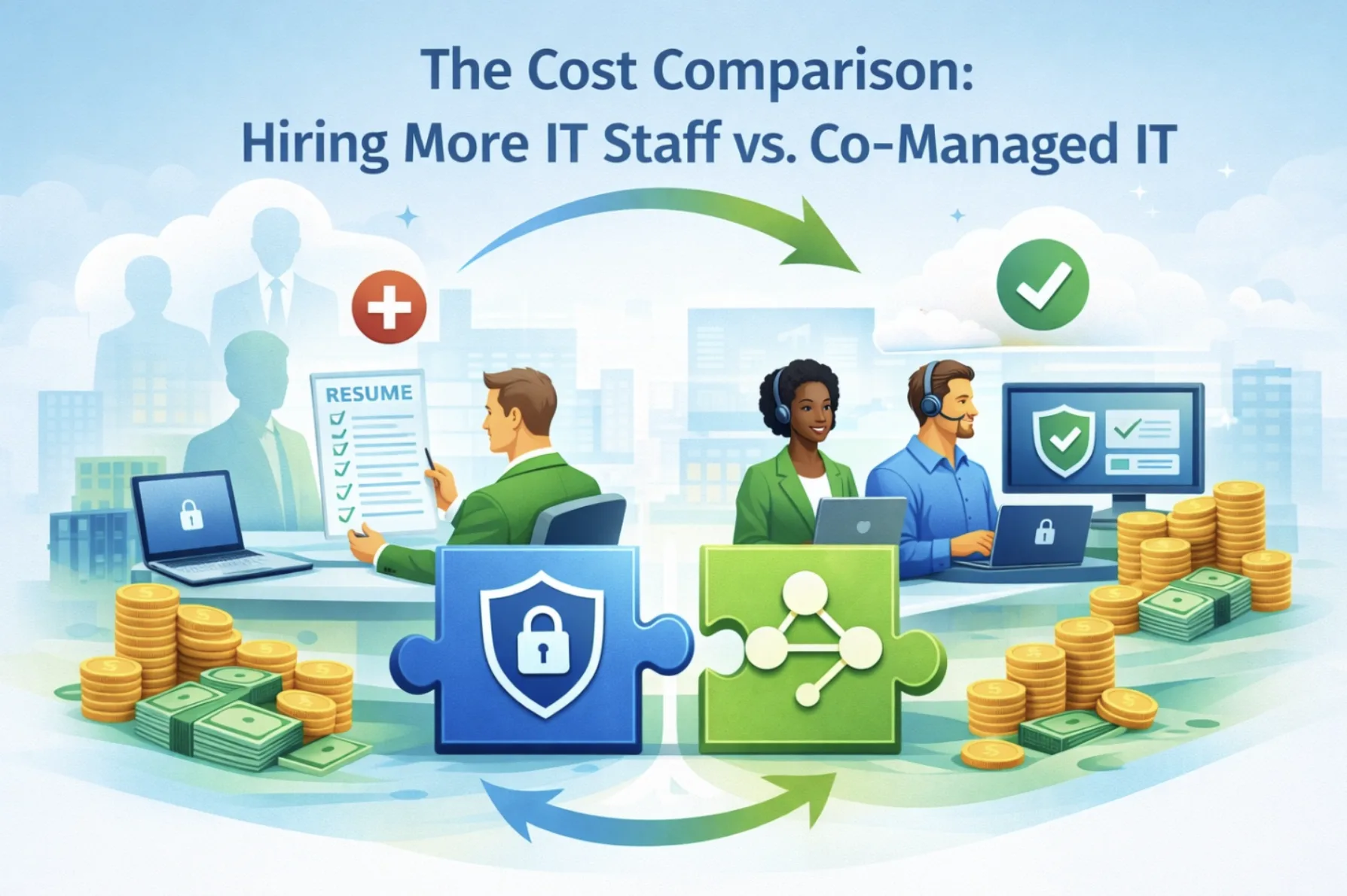
- Hire additional IT staff
- Explore outside support
At first glance, hiring feels like the most straightforward solution. More work requires more people — right?
Not always.
For regulated organizations facing rising compliance requirements, increasing cybersecurity threats, and growing operational complexity, the real question isn’t just:
“How much does another IT employee cost?”
It’s:
“What level of expertise, coverage, and risk reduction do we actually need — and what’s the smartest way to get it?”
Let’s break down the real cost comparison.
The True Cost of Hiring Additional IT Staff
When organizations evaluate hiring, they often focus on salary alone. But compensation is only one piece of the equation.
1. Salary and Benefits
For a qualified IT professional, especially one with cybersecurity or compliance experience, annual costs typically include:
- Base salary
- Health benefits
- Retirement contributions
- Payroll taxes
- Paid time off
Even a mid-level IT hire can represent a significant annual investment.
And if you need advanced security expertise? That cost increases substantially.
2. Training and Certifications
Technology changes constantly.
To stay current, IT staff require:
- Ongoing training
- Security certifications
- Vendor certifications
- Continuing education
These costs add up — both financially and in lost productivity while training occurs.
In regulated industries, maintaining up-to-date expertise isn’t optional. It’s expected.
3. Limited Skill Breadth
One additional hire equals one skill set.
But today’s IT environment often requires expertise in:
- Cybersecurity monitoring
- Cloud systems
- Backup and disaster recovery
- Network security
- Compliance documentation
- Risk assessments
It’s unrealistic to expect one person to excel equally in all these areas.
This is especially relevant given the layered security model we explored in January’s cybersecurity series.
4. Coverage Gaps
Even after hiring, you still face:
- Vacation coverage issues
- Sick days
- Staff turnover
- After-hours monitoring challenges
Threats don’t operate on a 9–5 schedule.
Hiring one additional employee does not automatically create 24/7 coverage.
The Co-Managed IT Alternative
Co-managed IT takes a different approach.
Instead of adding a single full-time employee, organizations gain access to a team of specialists across multiple disciplines.
This builds on what we discussed in:
Let’s look at how the financial comparison plays out.
1. Predictable Monthly Investment
Co-managed IT typically operates under a structured, predictable cost model.
This provides:
- Budget stability
- No surprise recruitment expenses
- No benefit administration
- No payroll tax increases
It also aligns with the cost-control advantages we outlined in February’s blog on how managed IT services reduce IT costs over time.
Want to compare hiring costs to a co-managed model?
2. Access to Multiple Skill Sets
Instead of hiring one person with limited specialization, co-managed IT provides access to:
- Security specialists
- Network engineers
- Compliance advisors
- Backup and disaster recovery experts
- Monitoring and alert response teams
This diversity reduces risk and improves overall resilience.
3. 24/7 Monitoring Without Staffing Shifts
Providing true around-the-clock monitoring internally would require multiple hires and shift coverage.
Co-managed IT delivers continuous oversight without expanding headcount.
This is particularly important for regulated organizations where monitoring and documentation are ongoing requirements, as discussed in our March posts on audit readiness and risk assessments.
4. Reduced Burnout and Turnover Risk
Overloading internal IT staff often leads to:
- Stress
- Delayed projects
- Increased turnover
Replacing experienced IT personnel is costly and disruptive.
Co-managed IT reduces pressure by redistributing operational workload — without replacing internal leadership.
5. Scalability Without Long-Term Hiring Commitments
Hiring is a long-term decision.
If business needs shift, reducing staff is difficult and disruptive.
Co-managed IT offers scalability:
- Increase support during audit cycles
- Expand security services as threats evolve
- Adjust scope as the organization grows
This flexibility reduces financial risk.
Real-World Example
A regional healthcare organization with a small internal IT team considered hiring a dedicated security analyst.
After evaluating:
- Salary and benefits
- Certification requirements
- Limited after-hours coverage
- Ongoing training needs
Leadership realized one hire would not fully solve the problem.
Instead, they implemented a co-managed model focused on:
- 24/7 monitoring
- Patch management
- Documentation maintenance
- Risk assessment support
The internal IT team retained strategic leadership. Security coverage improved. Costs became predictable.
And most importantly, the organization avoided expanding headcount while still strengthening compliance and protection.
When Hiring Makes Sense — and When It Doesn’t
Hiring additional staff may make sense when:
- Workload growth is long-term and consistent
- You need a dedicated on-site role
- The skill requirement is clearly defined
Co-managed IT often makes more sense when:
- Security demands are increasing
- Compliance documentation is expanding
- Monitoring requires 24/7 oversight
- You need broader expertise than one hire can provide
- Internal IT is stretched thin
The decision isn’t emotional — it’s strategic.
Frequently Asked Questions
Is co-managed IT always cheaper than hiring?
Can we start small and expand later?
Will our internal team feel replaced?
Does this improve audit outcomes?
Final Thought
Hiring another IT employee may solve part of the problem — but rarely all of it.
Co-managed IT offers something different:
- Broader expertise
- Continuous monitoring
- Compliance alignment
- Reduced burnout
- Predictable costs
- Preserved internal control
For regulated organizations balancing risk, compliance, and operational demands, the smarter investment isn’t always adding headcount — it’s expanding capability.
0 Comments