
You may have:
- A trusted internal IT manager
- A small but capable IT team
- Deep institutional knowledge inside your organization
The last thing you want is to replace that team or lose control over your systems.
But here’s the reality: compliance demands, cybersecurity threats, and operational expectations have grown dramatically. Internal IT teams are being asked to do more than ever — often without additional staff or resources.
That’s why more banks, credit unions, healthcare organizations, and regulated businesses are turning to co-managed IT.
Let’s clarify what that actually means — and why it’s becoming the preferred model for growing and regulated organizations.
What Co-Managed IT Actually Is (In Plain English)
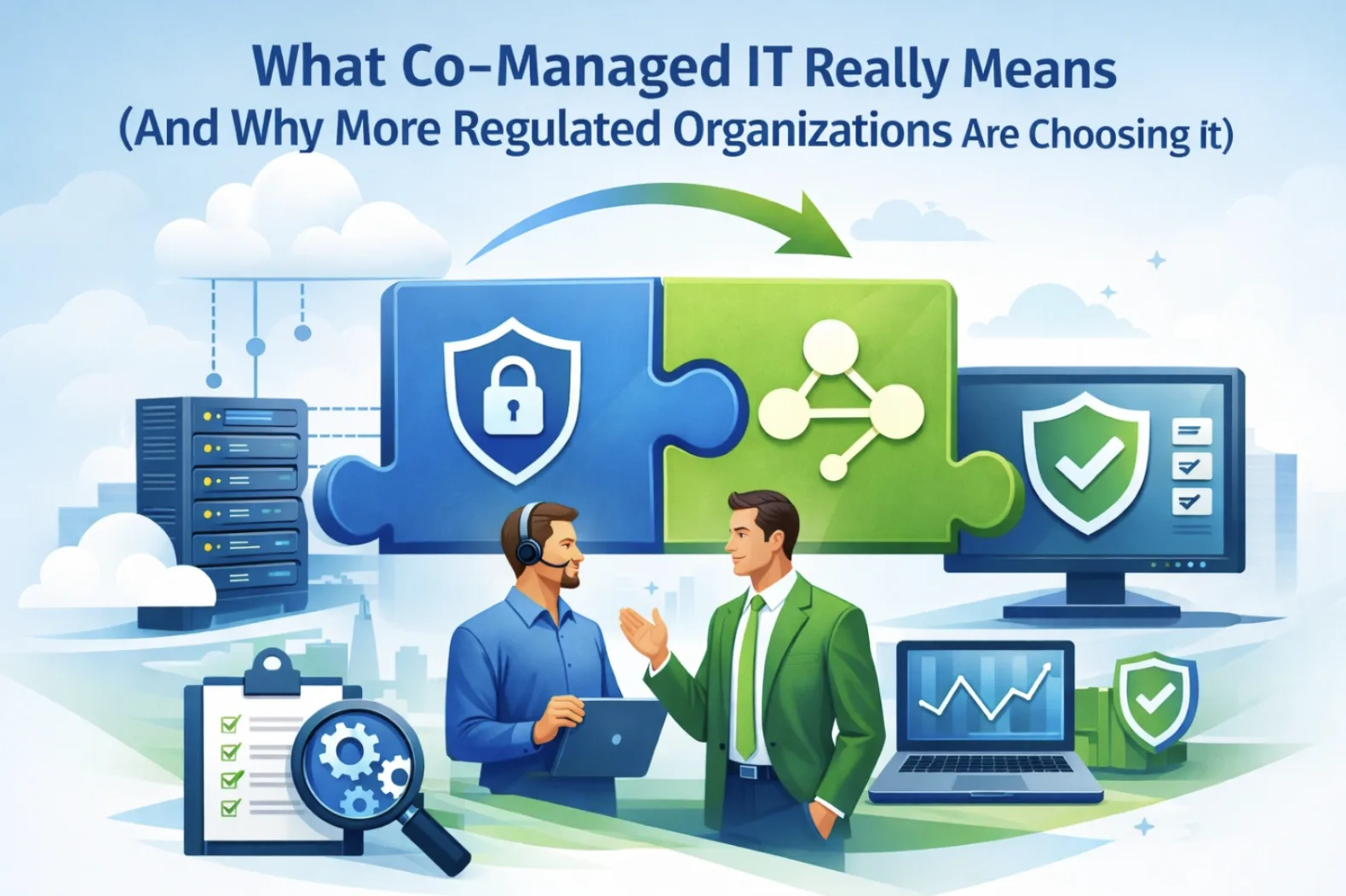
Co-managed IT is a collaborative partnership between your internal IT team and an external managed services provider.
Instead of replacing your internal staff, a co-managed model:
- Supports them
- Extends their capabilities
- Fills skill and coverage gaps
- Reduces overload
Think of it as expanding your IT department — without hiring full-time employees.
Your internal team maintains leadership and institutional knowledge. The external partner provides additional expertise, monitoring, tools, and scalability.
This model builds on the proactive foundation described in our February post on what managed IT services really include — but adapts it for organizations that already have internal IT.
How Co-Managed IT Is Different from Fully Managed IT
It’s helpful to clarify the differences.
Fully Managed IT
- The provider takes primary responsibility for IT operations
- Often used by organizations without internal IT staff
Break-Fix IT
- Reactive support only
- No ongoing monitoring or proactive oversight
- Limited security structure
Co-Managed IT
- Shared responsibility model
- Internal IT leads strategy and business alignment
- External partner handles monitoring, patching, security, documentation, and specialized expertise
For regulated organizations that have already outgrown break-fix IT — as discussed in our February blog on 7 signs your business has outgrown break-fix support — co-managed IT offers a middle ground that preserves control while strengthening capabilities.
Why Regulated Organizations Are Choosing Co-Managed IT
Regulated environments have unique pressures that make co-managed IT especially attractive.
1. Compliance Workload Is Increasing
Internal IT teams are now responsible for:
- Monitoring and responding to security alerts
- Maintaining documentation for audits
- Supporting risk assessments
- Ensuring patch management consistency
- Verifying backups
As we discussed in March’s blog on what regulators and auditors expect from your IT, these responsibilities require ongoing oversight — not occasional attention.
Co-managed IT helps distribute that workload without overburdening internal staff.
Threats are evolving quickly.
Internal IT teams may be excellent at:
- Supporting users
- Maintaining infrastructure
- Managing systems
But advanced cybersecurity tools, continuous monitoring, and threat detection often require deeper specialization.
This aligns with the layered defense model we outlined in January’s blog on what layered security really means.
Co-managed IT gives organizations access to:
- Security monitoring
- Advanced threat detection
- Vulnerability management
- Incident response support
Without hiring multiple specialists.
Not sure your internal team has the cybersecurity bandwidth they need?
In many regulated organizations, one or two individuals carry enormous responsibility.
This creates:
- Single points of failure
- Vacation coverage gaps
- Burnout risk
- Knowledge concentration
Co-managed IT reduces these risks by providing:
- Redundancy
- Shared documentation
- Additional technical depth
- Coverage during absences
Instead of replacing internal staff, it protects them.
Audit cycles can overwhelm small IT teams.
Co-managed IT supports:
- Documentation updates
- Evidence collection
- Security reporting
- Compliance alignment
This directly reinforces the compliance structure discussed in our March posts on IT documentation and risk assessments.
How the Shared Responsibility Model Works
A successful co-managed IT partnership clearly defines roles.
For example:
Internal IT May Handle:
- Business alignment
- Vendor coordination
- Day-to-day user relationships
- Strategic planning
Co-Managed Partner May Handle:
- 24/7 monitoring
- Patch management
- Backup oversight
- Security stack management
- Documentation maintenance
- Escalation support
This division creates clarity, not confusion.
When responsibilities are defined properly, co-managed IT increases efficiency instead of complicating operations.
Real-World Example
A regional financial institution had a small internal IT team responsible for infrastructure, support, and compliance.
As regulatory expectations increased, documentation lagged and security alerts began consuming more time than strategic initiatives.
Rather than outsourcing IT entirely, the organization implemented a co-managed model.
The result:
- Continuous monitoring handled externally
- Patch management standardized
- Documentation maintained consistently
- Internal IT freed up to focus on strategic improvements
The institution retained control — but reduced stress and risk.
Common Concerns About Co-Managed IT
Will we lose control?
Will this create confusion about responsibility?
Is co-managed IT only for large organizations?
Is this more expensive than hiring?
Final Thought
Co-managed IT isn’t about outsourcing responsibility. It’s about strengthening your internal team so they can succeed in an increasingly complex environment.
For regulated organizations facing growing compliance demands, rising cyber threats, and limited internal resources, co-managed IT provides balance:
- Control without overload
- Expertise without expanding headcount
- Compliance support without burnout
0 Comments