
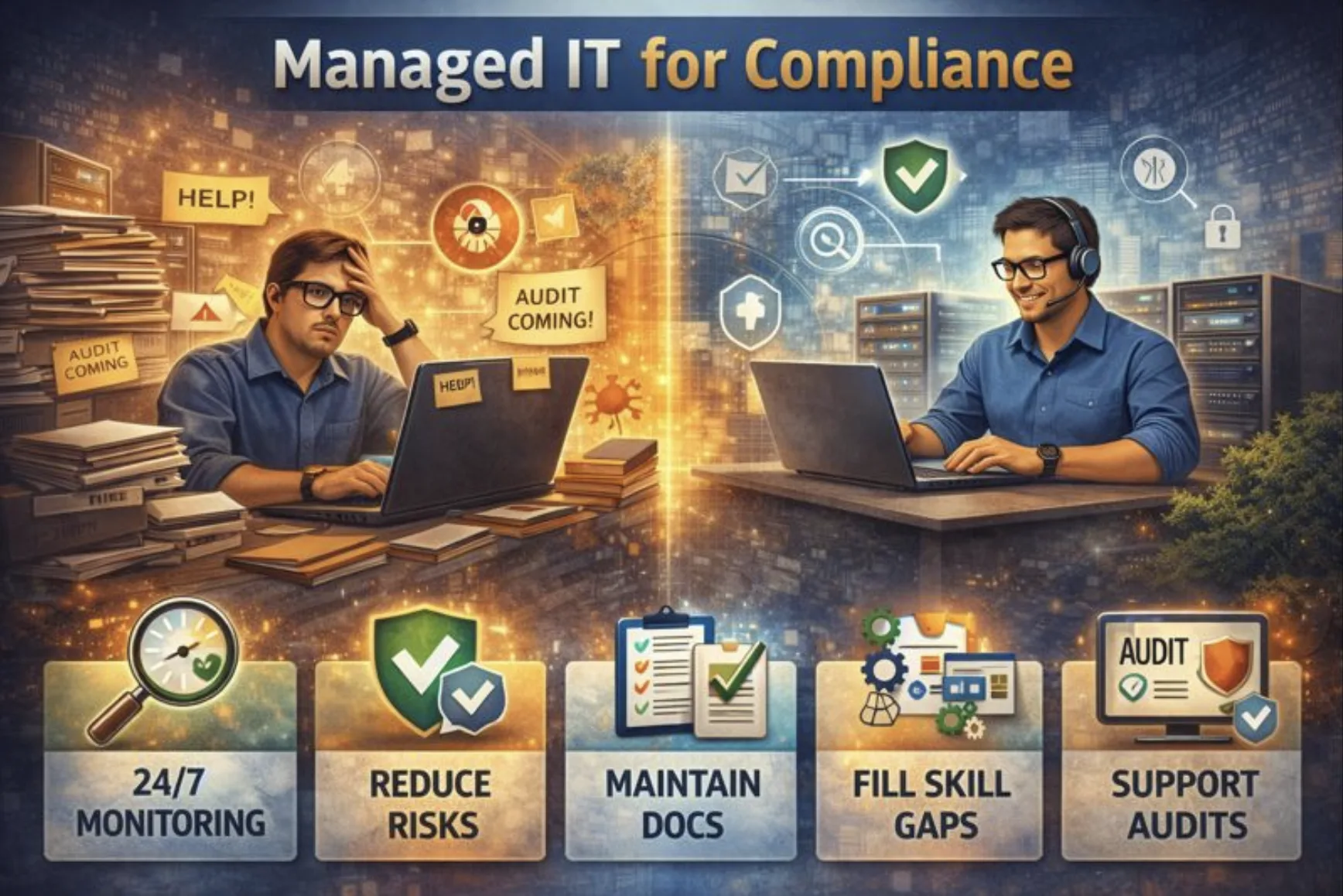
For regulated organizations, this creates a familiar challenge: the same small IT team is expected to keep systems running, protect sensitive data, support users, and prepare for audits—all at once.
Over time, this strain leads to burnout, gaps, and increased risk—not because teams aren’t capable, but because the workload has become unsustainable.
Managed IT services play a critical role in helping regulated organizations meet compliance expectations without overwhelming internal staff. Let’s explore how that support works and why it’s becoming essential.
Why Compliance Is Increasing the IT Workload
Compliance today extends far beyond written policies.
Internal IT teams are now responsible for:
- Continuous security monitoring
- Patch and vulnerability management
- Access reviews and user controls
- Backup verification and testing
- Documentation and evidence collection
- Supporting audits, exams, and insurance reviews
These responsibilities build on the expectations we discussed in:
- What Regulators and Auditors Expect from Your IT
- IT Documentation: The Unsung Hero of Compliance and Risk Management
The challenge is that most internal teams were not staffed—or structured—for this level of ongoing oversight.
The Hidden Risk of Overloaded IT Teams
When internal teams are stretched too thin, risk increases quietly.
Common warning signs include:
- Documentation falling behind
- Inconsistent patching schedules
- Security alerts not reviewed promptly
- Backups assumed to be working—but not verified
- Audit preparation rushed at the last minute
None of these issues stem from lack of effort. They stem from lack of time.
Is your IT team juggling more compliance work than they can reasonably handle?
Managed IT vs. Internal IT: Responsibility vs. Support
One important clarification: Managed IT does not remove accountability from your organization.
Regulators still expect leadership to understand and own compliance responsibilities.
What managed IT does is provide support, structure, and consistency so internal teams aren’t carrying everything alone.
This distinction mirrors what we discussed in our February pillar on what managed IT services really include—managed IT is about partnership, not replacement.
How Managed IT Reduces Compliance Burden
1. Continuous Monitoring and Oversight
Managed IT services provide 24/7 monitoring of:
- Systems
- Networks
- Security events
- Backup operations
Instead of internal teams reacting to issues after the fact, monitoring ensures problems are identified and addressed early—often before users notice.
This proactive approach supports the risk awareness discussed in why risk assessments are no longer optional for regulated organizations.
2. Consistent Patch and Vulnerability Management
Keeping systems up to date is one of the most time-consuming compliance-related tasks.
Managed IT ensures:
- Patches are tracked and applied consistently
- Vulnerabilities are addressed proactively
- Processes are documented and repeatable
This eliminates one of the most common audit findings: inconsistent patch management.
3. Documentation That Stays Current
Documentation is often where internal teams struggle the most.
Managed IT helps by:
- Standardizing documentation templates
- Updating records as systems change
- Centralizing evidence for audits and exams
Instead of scrambling before an audit, documentation becomes part of day-to-day operations—supporting the principles outlined in IT documentation as a compliance cornerstone.
Want documentation that stays current instead of falling behind?
Audits don’t just test systems—they test responsiveness.
Managed IT providers often assist with:
- Gathering requested evidence
- Explaining technical controls
- Answering auditor questions
- Reducing disruption to internal staff
This support allows internal teams to continue daily operations while audits proceed smoothly.
5. Filling Skill Gaps Without Hiring
Compliance often requires expertise across:
- Security
- Networking
- Cloud systems
- Backup and recovery
- Rick management
Hiring specialists for each area isn’t realistic for most organizations.
Managed IT provides access to a broader skill set—without expanding headcount or increasing internal workload.
Real-World Example
A local medical practice had a small internal IT team responsible for daily support, system maintenance, and compliance preparation.
As compliance requirements increased, documentation lagged and security reviews were rushed. The team was working harder—but still felt behind.
After engaging managed IT services, the organization:
- Implemented consistent monitoring and patching
- Centralized documentation and evidence
- Reduced audit preparation time significantly
- Allowed internal IT staff to focus on strategic initiatives
Compliance improved—not because the team worked more hours, but because they had the right support.
Why This Matters to Leadership
From a leadership perspective, compliance failures aren’t just IT issues—they’re business risks.
Overloaded IT teams increase the likelihood of:
- Missed findings
- Security incidents
- Downtime
- Staff burnout
Managed IT helps leadership balance:
- Accountability
- Risk management
- Operational efficiency
Without pushing internal teams past their limits.
Frequently Asked Questions
Does managed IT replace internal IT teams?
Is managed IT only for large organizations?
Does this help with audits and exams?
Absolutely. Consistency, documentation, and monitoring are core components of managed IT.
Final Thought
Compliance expectations aren’t slowing down—but internal IT teams can’t be expected to carry the full burden alone.
Managed IT services provide the structure, expertise, and consistency needed to support compliance without overwhelming internal staff.
When IT teams are supported, compliance becomes manageable, audits become predictable, and risk becomes easier to control.
0 Comments