
“Busy.”
Not because they’re doing anything wrong.
Because the job has fundamentally changed.
Ten years ago, an internal IT department might have focused primarily on maintaining servers, supporting users, replacing hardware, and troubleshooting network issues. Those responsibilities still exist, but today they’ve been joined by cybersecurity monitoring, compliance documentation, cloud management, identity protection, disaster recovery planning, vendor management, cyber insurance requirements, and an endless stream of software updates and security alerts.
The expectations placed on IT teams have grown dramatically.
For many organizations, the challenge isn’t finding better employees. It’s recognizing that even excellent IT professionals cannot do everything alone.
The Role of IT Has Expanded Faster Than Teams Have
Technology now touches every aspect of business operations.
Employees expect immediate support regardless of where they work. Customers expect uninterrupted digital services. Regulators expect documented controls and continuous oversight. Leadership expects strategic guidance that aligns technology investments with business objectives.
Meanwhile, cybercriminals don’t limit their activity to business hours.
Threats emerge around the clock.
Security alerts don’t wait until Monday morning.
Software vulnerabilities often require immediate attention.
The result is that internal IT teams are expected to deliver strategic planning, operational support, cybersecurity expertise, compliance management, and emergency response simultaneously.
That’s an enormous responsibility for any department, especially in organizations where one or two people manage the entire technology environment.
This isn’t a staffing problem.
It’s a capacity problem.
Capacity and Capability Are Different Challenges
When organizations recognize their IT team is overwhelmed, the first instinct is often to hire another employee.
Sometimes that’s the right decision.
Often, it isn’t.
Adding another full-time employee can help with workload, but it doesn’t necessarily provide the specialized expertise modern organizations require.
One day the challenge is responding to a sophisticated phishing campaign.
The next, it’s preparing documentation for an audit.
The following week involves planning a cloud migration while simultaneously managing user support tickets.
Finding one individual who excels in every one of those disciplines is increasingly unrealistic.
A community bank may need guidance interpreting evolving regulatory expectations. A healthcare organization may require assistance with security monitoring while its internal team focuses on supporting clinical staff. A manufacturer may need specialized expertise for infrastructure modernization without hiring permanent specialists.
These aren’t failures of internal IT. They’re examples of technology becoming too broad for any single individual, or even a small team, to manage alone.
The Best Partnerships Strengthen Existing Teams
One of the biggest misconceptions about managed IT services is that bringing in outside expertise means replacing internal IT staff.
In reality, the most successful partnerships do exactly the opposite.
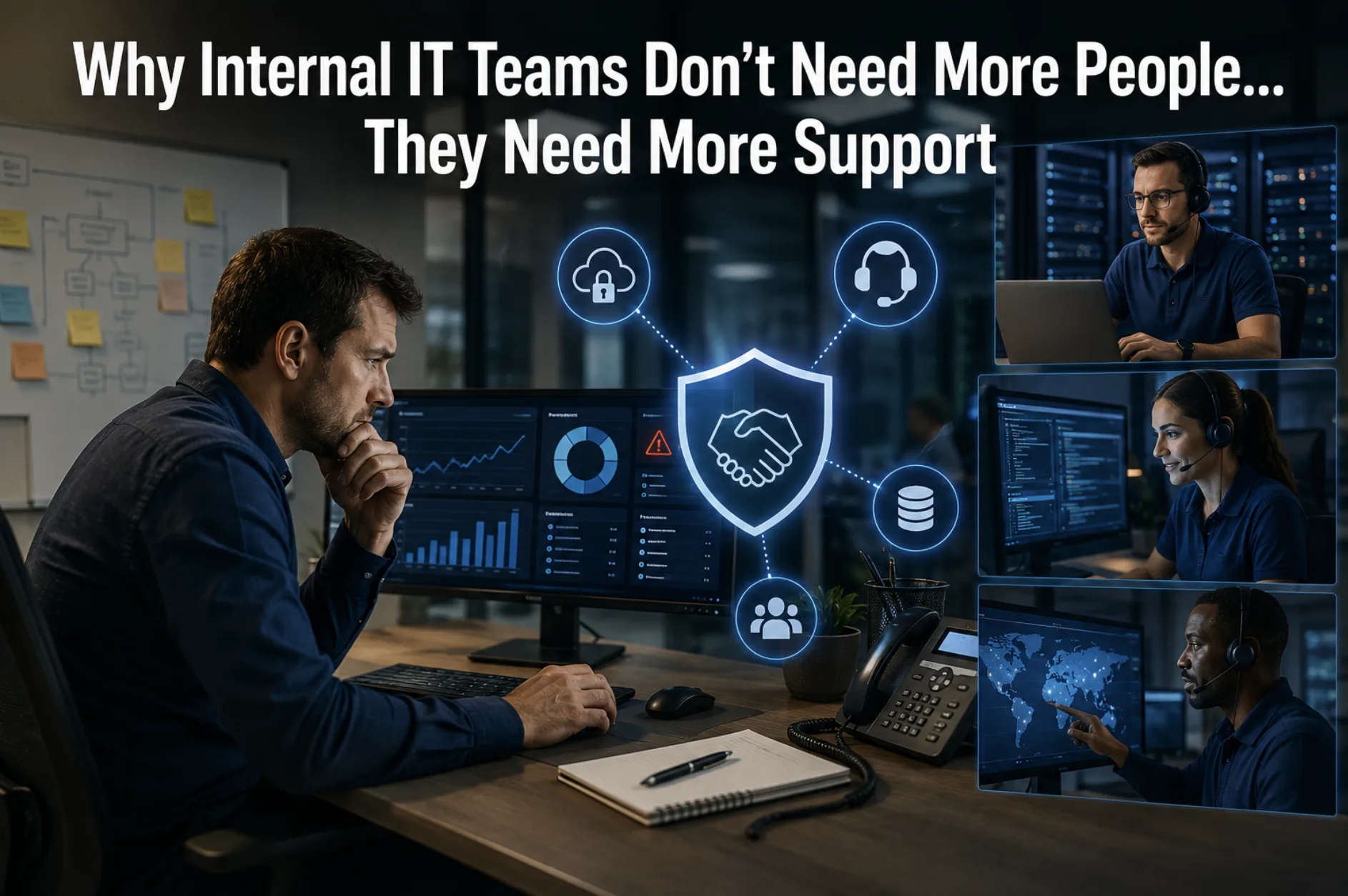
Co-Managed IT is designed to strengthen internal teams by filling gaps in capacity, specialized expertise, and around-the-clock operational support.
Your internal team continues leading the technology strategy because no one understands your business better.
An external partner provides additional resources where they’re needed most—continuous monitoring, cybersecurity expertise, compliance guidance, infrastructure projects, help desk escalation, documentation, and strategic planning.
Think of it as adding specialists to your existing team instead of asking generalists to become experts in every discipline.
As we’ve discussed in our blog, Co-Managed IT Services: A Smarter Solution for Overstretched IT Teams, organizations increasingly recognize that modern IT success depends on expanding capabilities rather than simply increasing headcount. Likewise, How Managed IT Supports Compliance Without Overloading Your Internal Team explains how shared responsibilities improve operational consistency while reducing the burden of ongoing compliance activities.
Supporting Business, Not Just Technology
One of the biggest advantages of Co-Managed IT is that it allows internal teams to spend more time on the work that creates business value.
Instead of constantly reacting to password resets, software updates, after-hours alerts, and routine maintenance, internal IT professionals can focus on projects that improve operations.
That might include implementing new technologies, supporting business growth, improving user experience, or helping leadership plan future initiatives.
At the same time, cybersecurity monitoring continues.
Systems continue receiving updates.
Documentation remains current.
Compliance tasks move forward.
The organization benefits from stronger operational consistency without requiring existing employees to work longer hours or divide their attention even further.
This collaborative model doesn’t diminish the value of internal IT.
It allows them to contribute where their institutional knowledge makes the greatest difference.
Building Resilience Through Partnership
The previous articles in this series explored operational complacency, proactive planning, and business continuity.
Each of those topics shares a common theme.
Consistency.
Cybersecurity requires continuous monitoring.
Technology planning requires regular assessment.
Disaster recovery requires ongoing testing.
None of those responsibilities happen once.
They become part of an organization’s operational rhythm.
That’s precisely where many internal IT departments begin feeling overwhelmed.
Not because they lack technical ability but because maintaining that level of consistency across every responsibility becomes increasingly difficult as technology environments grow more complex.
Co-Managed IT helps organizations sustain that consistency by ensuring routine operational activities continue even when internal priorities shift.
A Stronger Organization Starts with a Stronger IT Team
Technology should enable growth, not become another obstacle to managing it.
The most resilient organizations recognize that supporting their IT teams is ultimately an investment in the entire business.
When internal IT has access to additional expertise, continuous monitoring, specialized resources, and strategic guidance, everyone benefits.
Employees receive faster support.
Leadership gains better visibility into technology risk.
Compliance efforts become more consistent.
Cybersecurity improves.
Projects move forward with fewer delays.
Most importantly, internal IT professionals are no longer expected to carry every responsibility alone.
As technology continues evolving, the organizations that succeed won’t necessarily be those with the largest IT departments.
They’ll be the ones that build the strongest partnerships, giving their teams the support they need to adapt, innovate, and protect the business with confidence.
Technology has become too important and too complex for any organization to rely on one person or one team to do it all. The goal isn’t to replace internal IT; it’s to give them the resources, expertise, and support they need to help the business thrive. Organizations that invest in those partnerships aren’t just strengthening their IT operations… they’re building greater resilience for the future.
0 Comments