
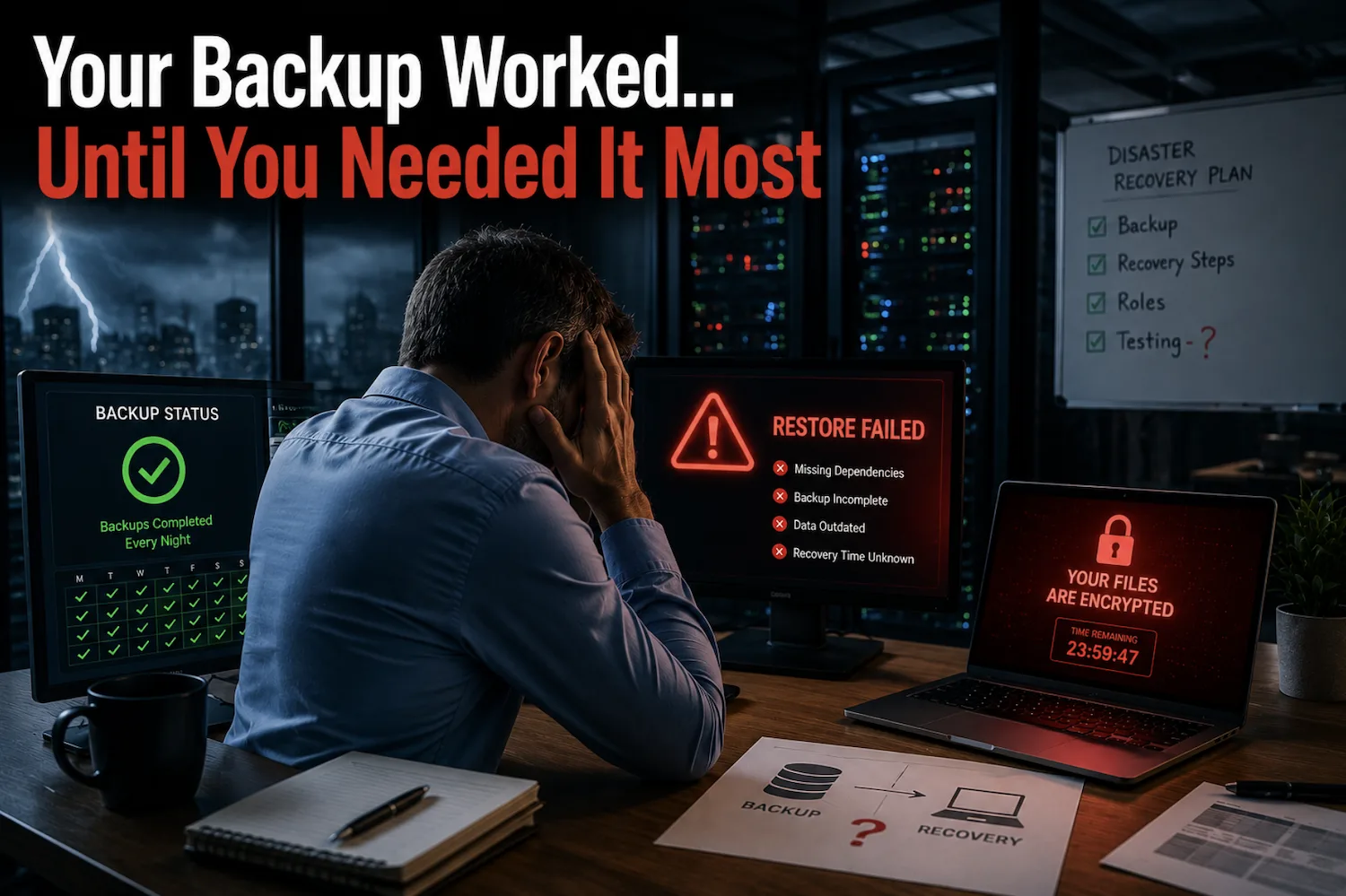
The backups ran every night. The monitoring dashboard showed green checkmarks. There hadn’t been a major outage in years, and everyone assumed that if something ever happened, restoring the systems would be straightforward.
Then ransomware struck.
The IT team quickly discovered that while the backup files existed, restoring critical applications would take far longer than expected. Some data wasn’t as current as leadership believed. Several systems had dependencies that weren’t documented, and no one had tested the recovery process in over a year.
The organization had done what many businesses do. They invested in backups.
What they hadn’t invested in was recovery.
It’s an important distinction, and one that becomes painfully clear during a crisis.
Backups Are Only One Piece of Business Continuity
Ask most business leaders whether their organization has backups, and the answer is almost always yes.
Ask how long it would take to fully restore operations after a cyberattack, hardware failure, or natural disaster, and the answer is often much less certain.
That’s because backup and recovery are not the same thing.
A backup is a copy of your data.
Recovery is your organization’s ability to restore systems, applications, and operations quickly enough to minimize disruption.
Those are two very different capabilities.
Imagine a community bank that successfully restores its customer database after an incident but online banking remains unavailable because supporting authentication systems weren’t included in the recovery plan. Or consider a medical practice that restores patient records but cannot access scheduling software, imaging systems, or secure communications.
Technically, the backups worked.
Operationally, the business is still offline.
Business continuity isn’t measured by whether your data exists. It’s measured by how quickly your organization can resume serving customers.
Downtime Is More Expensive Than Most Organizations Realize
Every hour of downtime creates consequences that extend far beyond the IT department.
Employees lose productivity.
Customers experience delays.
Revenue-generating activities stop.
Leadership shifts its attention from strategic priorities to crisis management.
For regulated organizations, the impact is even greater.
Community banks and credit unions may face increased regulatory scrutiny following extended outages. Healthcare organizations risk disruptions to patient care and clinical workflows. Manufacturers, professional services firms, and local governments all depend on technology to deliver essential services.
The longer systems remain unavailable, the greater the operational, financial, and reputational impact becomes.
That’s why business continuity planning has evolved from an IT initiative into a leadership responsibility.
As we’ve discussed in Why Downtime Is a Board-Level Risk (Not Just an IT Problem), today’s executives are increasingly expected to understand recovery readiness because technology outages affect every aspect of business operations. Similarly, The Hidden Costs of IT Downtime explains that the true cost of an outage includes lost productivity, customer confidence, compliance exposure, and operational disruption—not simply the expense of repairing technology.
The Questions Every Organization Should Be Able to Answer
Many organizations are surprised by how difficult it is to answer a few seemingly simple questions:
- How quickly could we restore our critical systems?
- Which applications must come back online first?
- When was our disaster recovery plan last tested?
- Are our backups protected from ransomware?
- Could we continue operating if our primary systems were unavailable tomorrow?
These questions aren’t intended to create anxiety.
They’re designed to reveal visibility.
Organizations often discover that they have reliable backup software but no documented recovery sequence. Others realize their recovery objectives no longer reflect current business operations because new applications have been added over time.
Without regular review, business continuity plans gradually become outdated—even when backup technology continues running every day.
Testing Builds Confidence
One of the biggest misconceptions about disaster recovery is that successful backups automatically mean successful recovery.
In reality, recovery should be tested just as regularly as backups are performed.
Testing confirms that backup files are usable, recovery procedures remain accurate, personnel understand their responsibilities, and systems can be restored within acceptable timeframes.
It also identifies small issues before they become major problems.
Perhaps an application requires additional licensing during recovery. Maybe a recently implemented cloud service isn’t included in backup policies. Or perhaps a key employee who once managed the recovery process has since left the organization.
These discoveries are far less expensive during a scheduled test than during an unexpected emergency.
Regular testing also gives executive leadership something equally valuable: confidence.
Instead of hoping systems can be restored, leadership knows they can.
Recovery Planning Has Changed
Today’s disaster recovery strategies look very different than they did even five years ago.
Modern cyberattacks specifically target backup systems because attackers understand their importance. If backup repositories can be encrypted or deleted, organizations have fewer recovery options and are more likely to pay a ransom.
That’s why many organizations now incorporate additional protections such as immutable storage, offsite replication, and air-gapped backups into their business continuity strategy.
These approaches help ensure that recovery data remains available even if production systems are compromised.
Equally important is ongoing monitoring and proactive testing. A disaster recovery plan isn’t a document that sits on a shelf waiting for an emergency. It is an operational process that evolves alongside the organization.
As highlighted in Link Computer’s business continuity resources, the conversation has shifted from whether disruption will occur to how quickly an organization can recover when it does. Recovery objectives measured in minutes rather than days, proactive testing, and secure offsite protection have become essential components of operational resilience.
Business Continuity Is About More Than Technology
Organizations sometimes think of disaster recovery as an insurance policy they hope never to use.
In reality, it is an investment in business continuity.
Customers expect uninterrupted service.
Employees expect reliable systems.
Boards expect operational resilience.
Regulators expect organizations to prepare for disruption rather than simply react to it.
Meeting those expectations requires more than dependable technology. It requires documented processes, clearly defined recovery priorities, regular testing, and leadership visibility into how the organization will continue operating during unexpected events.
The strongest business continuity strategies aren’t judged by the quality of the backup software alone. They’re judged by how effectively they help the organization continue serving customers when everything else has gone wrong.
A backup may protect your data.
A tested recovery strategy protects your business.
Business continuity isn’t measured by the number of backups you have—it’s measured by your ability to recover when your organization needs it most. Taking time to review, test, and strengthen your recovery strategy today can make the difference between a temporary disruption and a prolonged business crisis tomorrow.
0 Comments