
Department leaders start evaluating priorities for the coming year, finance teams begin shaping budgets, and executives make decisions about where to invest limited resources. Yet one area is often overlooked until it becomes a problem: the health of the organization’s IT environment.
Technology has become the foundation of nearly every business operation. It supports customer service, employee productivity, compliance, communications, and security. But unlike buildings or fleet vehicles, IT infrastructure rarely receives a routine “inspection.” Instead, organizations often discover issues only after systems fail, cybersecurity incidents occur, or an auditor identifies a gap.
An annual IT health check changes that approach. Rather than reacting to problems, it provides a clear picture of where your technology stands today and where investments will deliver the greatest value tomorrow.
Technology Ages Faster Than Most Organizations Realize
Every piece of technology has a lifecycle.
Servers reach end-of-support. Firewalls become outdated. Software vendors discontinue older versions. Hardware that once met business needs gradually struggles to keep up with modern workloads.
The challenge is that these changes rarely happen all at once.
Instead, technology ages incrementally. A server is postponed for replacement because it still works. An operating system remains in production because upgrading would be inconvenient. A network switch continues running long after its warranty expires.
Individually, none of these decisions seems significant. Collectively, they increase operational risk.
Consider a healthcare practice preparing next year’s budget. Without a current assessment, leadership may approve funding for new workstations because employees have complained about slow computers. Meanwhile, the organization’s firewall is approaching end-of-life and no longer receives critical security updates. The most visible problem receives attention, while the more significant business risk remains hidden.
An IT health check helps organizations prioritize investments based on risk, business impact, and long-term value rather than urgency alone.
Security Is Only One Part of the Picture
Many business leaders associate technology assessments exclusively with cybersecurity.
Security is certainly an important component, but a comprehensive IT health check evaluates much more.
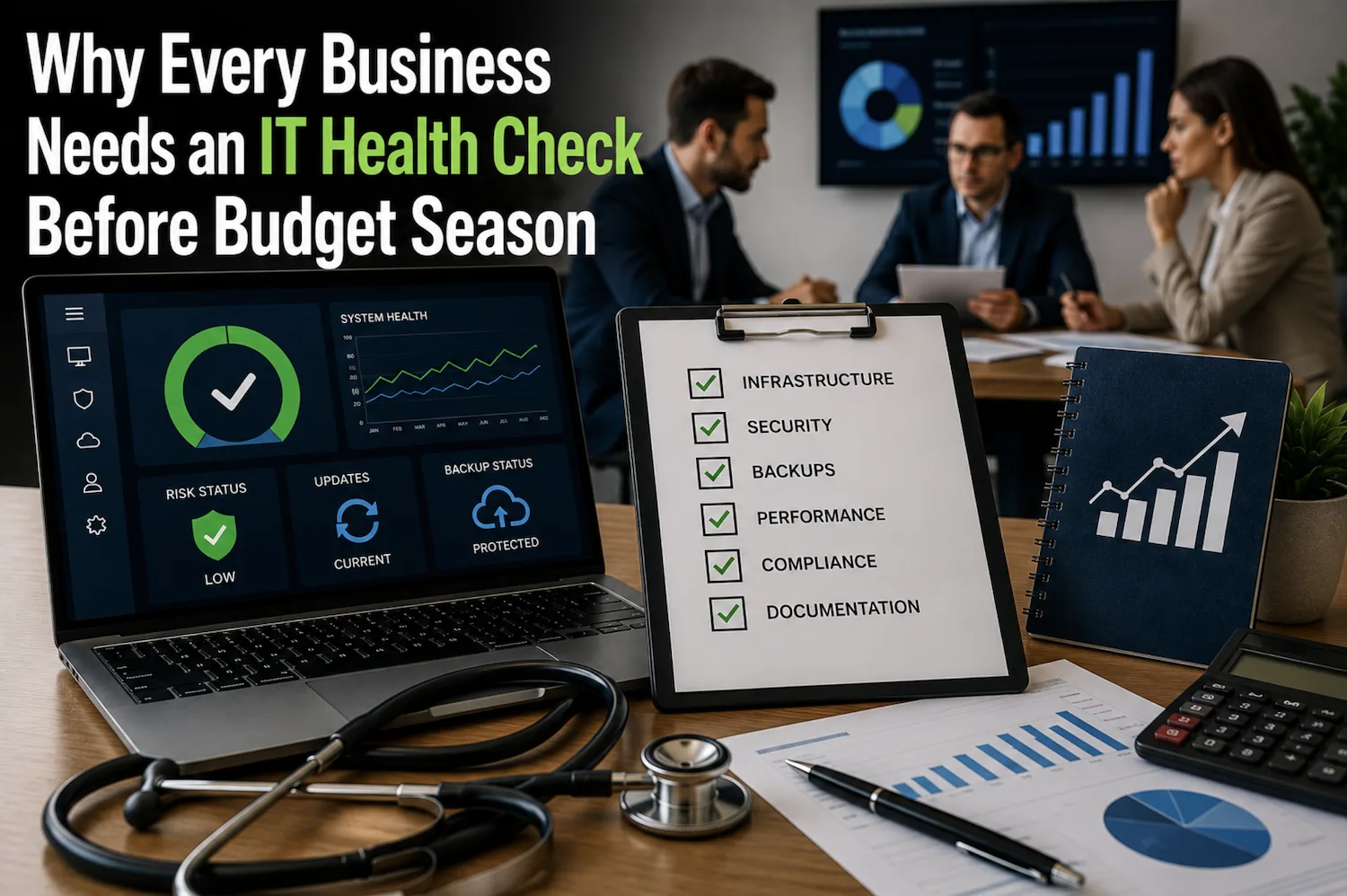
It examines the overall health of the technology environment, including:
- Infrastructure lifecycle and hardware age
- Patch management and software updates
- Backup and disaster recovery readiness
- Network performance and reliability
- User access and identity management
- Cloud services and licensing
- Documentation and operational processes
- Compliance readiness
Looking at these areas together provides leadership with a complete understanding of operational risk instead of isolated technical issues.
For example, an organization may have excellent endpoint protection and multi-factor authentication but still lack documented recovery procedures or regularly tested backups. Those operational gaps may not appear during daily business activities, but they become critical during a ransomware attack, hardware failure, or natural disaster.
Technology should be evaluated as an interconnected business system… not a collection of independent tools.
Better Budgets Begin With Better Information
Budget planning is fundamentally about making informed decisions.
Unfortunately, many IT budgets are based on assumptions rather than current data.
“We probably need new computers.”
“I think our storage is running low.”
“We should budget something for cybersecurity.”
Those estimates may be directionally correct, but they don’t provide leadership with enough information to prioritize spending effectively.
An IT health check replaces assumptions with evidence.
Instead of wondering whether infrastructure should be replaced, leadership receives a roadmap identifying which systems require immediate attention, which can safely remain in service, and which projects should be planned over the next several years.
This approach also helps avoid unexpected expenses.
Emergency technology purchases are almost always more disruptive and more expensive than planned investments. Replacing a failed server during a business outage rarely provides the opportunity to compare options, negotiate pricing, or coordinate implementation around business operations.
Planning ahead gives organizations greater control over both cost and risk.
As we’ve discussed in our blog, How Managed IT Services Actually Reduce IT Costs Over Time, proactive planning consistently costs less than reacting to unexpected failures because it reduces downtime, emergency support, and unplanned capital expenses. Likewise, What Managed IT Services Really Include explains how ongoing monitoring and strategic planning help organizations stay ahead of these challenges instead of constantly responding to them.
An IT Health Check Supports More Than Your Budget
A thorough assessment creates value well beyond financial planning.
For regulated organizations, it also strengthens compliance efforts.
Regulators increasingly expect organizations to demonstrate consistent risk management, documented processes, and proactive oversight of technology environments. An assessment helps identify areas where documentation may be incomplete, systems require updates, or operational processes have drifted from established policies.
It also creates meaningful conversations between executive leadership and IT.
Instead of discussing isolated technical issues, organizations begin talking about business priorities.
Which systems are most critical to operations?
How quickly could they be restored after an outage?
What technology investments will improve resilience over the next three years?
Where are the organization’s greatest operational risks?
These are strategic business discussions, not simply IT conversations.
An IT health check gives leadership the information needed to answer them with confidence.
Questions Every Leadership Team Should Be Asking
Before finalizing next year’s technology budget, every leadership team should be able to answer a few important questions:
- Which systems are approaching end-of-life?
- Have our backups been tested recently?
- Are critical security updates consistently applied?
- Do employees have only the access they need?
- Are we prepared for our next compliance audit?
- Which technology investments will reduce business risk the most?
- Are we solving today’s problems or planning for tomorrow’s?
If those answers aren’t immediately available, an IT health check can provide the visibility needed to make informed decisions.
More importantly, it shifts technology planning from reactive spending to strategic investment.
A Stronger Business Starts With Visibility
Healthy organizations don’t wait for equipment to fail before evaluating their technology. They don’t assume security controls remain effective simply because they worked last year. And they don’t build budgets based on guesswork.
They regularly assess where they stand, identify emerging risks, and make thoughtful investments that support long-term business objectives.
An IT health check isn’t about finding fault with your existing technology or your internal IT team. It’s about gaining visibility. When leadership understands the condition of its technology environment, it can make smarter decisions, reduce unexpected costs, improve cybersecurity, and strengthen operational resilience.
Operational resilience begins with knowing where you stand today. An annual IT health check provides the clarity to plan confidently for tomorrow.
The most effective technology decisions are rarely made during a crisis. They happen when organizations take the time to evaluate where they are, understand where they’re headed, and plan accordingly. An annual IT health check provides that perspective, helping business leaders make informed investments that support security, resilience, and long-term success.
0 Comments