
AI Governance: The Conversation Every Regulated Business Should Be Having
Most conversations about Artificial Intelligence focus on what AI can do.
Faster reporting.
Improved productivity.
Operational efficiency.
Automation.
Cost reduction.
Far fewer conversations focus on how AI should be governed.
That is becoming one of the biggest gaps in AI adoption today.
For regulated organizations, AI governance is no longer optional.
As businesses increasingly integrate AI into daily operations, leadership teams must ensure those tools are being used responsibly, securely, and consistently. Without governance, organizations risk creating operational blind spots, compliance exposure, cybersecurity concerns, and inconsistent decision-making.
The reality is that most technology-related problems are not caused by technology failure alone.
They are caused by process failures.
Lack of oversight.
Inconsistent policies.
Poor visibility.
Weak accountability.
AI is quickly following the same pattern.
Organizations that implement AI without governance may initially improve productivity—but they also increase the likelihood of unmanaged risk.
What AI Governance Actually Means
The term “AI governance” can sound overly technical or intimidating.
In practice, AI governance is much simpler than many organizations realize.
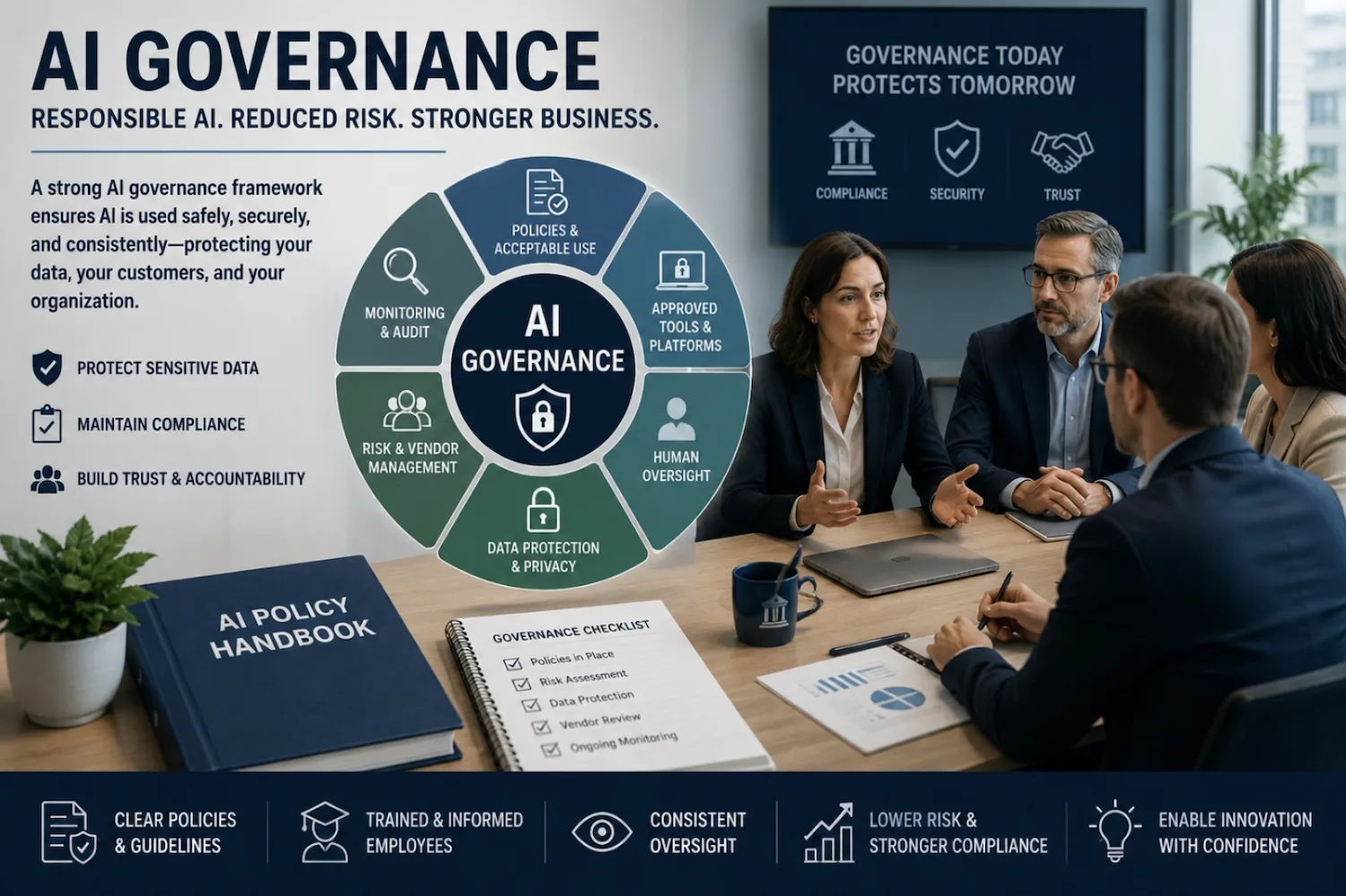
AI governance is the framework that defines how AI tools are used, monitored, approved, and managed within the organization.
It establishes:
- Acceptable use policies
- Employee responsibilities
- Approved platforms
- Oversight processes
- Data protection standards
- Documentation requirements
- Review procedures
- Accountability expectations
Most importantly, governance creates consistency.
Without governance, individual departments often make independent decisions about AI usage. Employees begin using tools based on convenience rather than security or compliance considerations.
This creates what many organizations are now experiencing as “shadow AI” — unapproved AI usage occurring outside formal oversight.
For example, one employee may use a public AI tool to summarize customer communications while another uses AI-generated content for policy drafting without review. Different departments may adopt different platforms with completely different security standards.
Over time, that inconsistency becomes difficult to manage.
AI governance helps organizations establish boundaries before AI adoption becomes fragmented and difficult to control.
Importantly, governance is not about preventing employees from using AI.
It is about enabling safer, more responsible adoption.
The organizations seeing the most success with AI today are not necessarily restricting innovation.
They are creating structured environments where innovation can happen without compromising security, compliance, or operational stability.
Why Governance Matters More in Regulated Industries
Every organization faces some level of AI-related risk.
Regulated businesses face significantly more.
Community banks, credit unions, healthcare organizations, and compliance-driven businesses operate under strict expectations around data handling, operational oversight, cybersecurity, and accountability.
That means AI adoption cannot happen casually.
Regulators increasingly expect organizations to understand:
- What technologies are being used
- How sensitive information is protected
- What third-party vendors have access to data
- What controls exist around employee activity
- How decisions are documented
- What oversight mechanisms are in place
AI governance directly intersects with all of these areas.
For example, if employees are using public AI tools without approval, organizations may unknowingly expose sensitive operational or customer information. If AI-generated outputs are used without validation, inaccurate information may enter reports, communications, or compliance documentation.
Even if no formal AI regulations currently apply, organizations are still responsible for maintaining strong operational controls.
That is why governance matters.
As explained in What Regulators and Auditors Expect from Your IT, regulators consistently focus on visibility, accountability, documentation, and risk management maturity.
AI usage now falls directly into those conversations.
Governance also helps organizations address vendor risk.
Many AI platforms process large amounts of organizational data. Businesses need to understand where that data is stored, how it is protected, whether it is retained, and what happens if a vendor experiences a security incident.
Without governance, organizations often adopt AI tools faster than they evaluate the associated risks.
That creates dangerous operational blind spots.
Building a Practical AI Governance Framework
One reason many organizations delay governance discussions is because they assume governance requires massive enterprise-level programs.
In reality, effective AI governance often begins with a few practical foundational steps.
The first step is creating an AI acceptable use policy.
Employees need clear guidance around:
- Which AI tools are approved
- What types of data cannot be entered into AI systems
- When human review is required
- What activities are restricted
- How AI-assisted work should be documented
Without written policies, organizations rely on assumptions and inconsistent employee judgment.
Leadership ownership is equally important.
AI governance cannot exist solely within IT departments.
Because AI affects operations, compliance, cybersecurity, risk management, and business decision-making, leadership teams must remain actively involved.
Organizations should also establish formal vendor review processes.
Before approving AI platforms, businesses should evaluate:
- Security controls
- Encryption standards
- Audit logging capabilities
- Compliance certifications
- Data retention policies
- Access management features
- Breach notification procedures
These evaluations increasingly overlap with broader cybersecurity governance conversations.
Our article on Why Risk Assessments Are No Longer Optional for Regulated Organizations explains why continuous visibility into operational and technology risk has become essential for modern organizations.
AI should now be included within those assessments.
Employee education is another major component of governance.
Most employees are not intentionally creating risk.
They simply may not understand:
- How AI platforms handle data
- Why public AI tools create exposure
- When outputs require validation
- What information should remain restricted
Training helps create consistency while reducing accidental exposure.
Governance should also evolve over time.
AI capabilities are advancing rapidly, and organizational usage patterns will continue changing. Policies and oversight processes should be reviewed regularly as new tools, risks, and operational needs emerge.
Governance Will Become a Competitive Advantage
Many organizations currently view AI governance as a defensive measure.
In reality, strong governance will increasingly become a business advantage.
Organizations with mature governance frameworks will be better positioned to:
- Adopt AI confidently
- Respond to regulatory scrutiny
- Reduce operational risk
- Protect customer trust
- Scale AI usage responsibly
- Demonstrate accountability to boards and auditors
This matters because trust remains critically important in regulated industries.
Customers expect financial institutions and healthcare organizations to protect sensitive information and maintain operational stability.
Strong governance reinforces that trust.
It also improves internal consistency.
Organizations with documented governance standards can scale AI initiatives more effectively because employees understand expectations, approved tools, and accountability requirements.
Without governance, organizations often experience fragmented adoption, inconsistent security practices, and growing operational confusion.
Over time, governance maturity will likely become part of broader cybersecurity and compliance evaluations.
Businesses that establish governance early will be far better prepared as AI-related expectations continue evolving.
AI Governance Is Ultimately About Responsible Growth
Artificial Intelligence will continue changing how organizations operate.
That reality is no longer theoretical.
The businesses that benefit most from AI over the next several years will not simply be the fastest adopters.
They will be the organizations that combine innovation with structure, visibility, accountability, and oversight.
AI governance is what makes that possible.
Without governance, organizations risk creating operational inconsistency, compliance gaps, and security exposure faster than leadership teams can respond.
With governance, organizations can adopt AI more confidently while maintaining the operational controls and accountability regulated industries require.
Organizations that begin building governance frameworks today will be significantly better positioned to adapt as AI capabilities, regulations, and operational expectations continue evolving.
0 Comments