
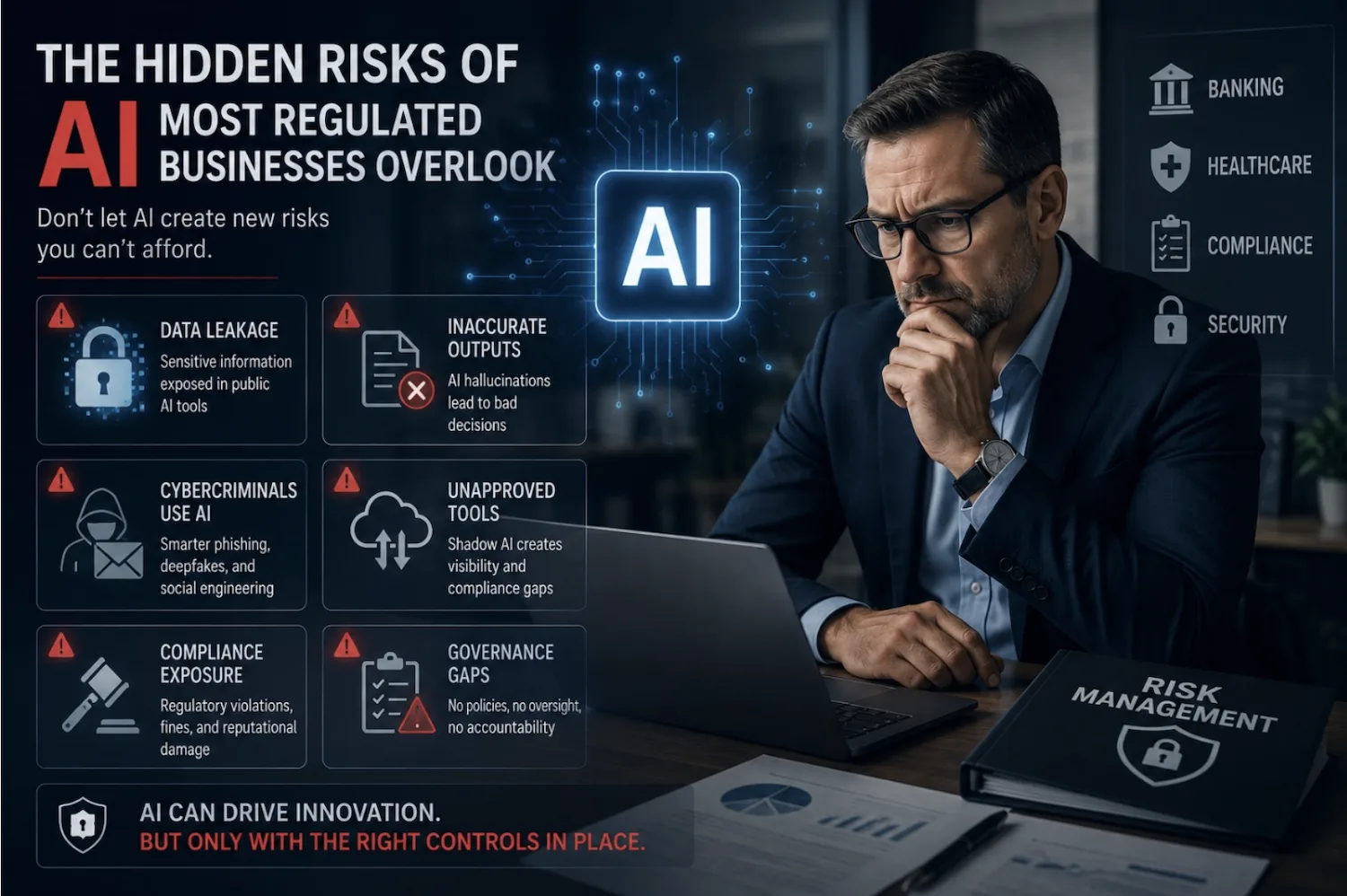
The Hidden Risks of AI Most Regulated Businesses Overlook
Artificial Intelligence is often discussed in terms of opportunity.
Organizations hear about productivity gains, automation, operational efficiency, and faster decision-making. Employees are experimenting with AI tools daily, and leadership teams increasingly feel pressure to “keep up” with competitors adopting AI-driven technologies.
But many organizations are focusing heavily on what AI can do without fully understanding the risks that come with it.
For regulated businesses, that creates a dangerous imbalance.
The biggest AI threats today are not futuristic scenarios involving robots replacing employees.
Most AI-related risk is far more ordinary.
It comes from employees unknowingly exposing sensitive information, relying on inaccurate AI-generated content, or using unapproved tools without oversight.
In regulated industries, even small AI mistakes can create compliance concerns, operational disruption, reputational damage, and cybersecurity exposure.
That is why AI adoption cannot be separated from broader conversations around governance, cybersecurity, and risk management.
Data Leakage Is One of the Biggest Immediate Risks
One of the most common AI-related risks organizations face today is employees entering sensitive information into public AI tools.
In many cases, employees are simply trying to work more efficiently.
A manager may ask an AI platform to summarize a customer report. An employee may upload financial information into an AI chatbot to analyze trends. A healthcare administrator may paste operational notes into a generative AI platform to draft documentation.
The problem is that many users do not fully understand how public AI systems process and retain data.
Depending on the platform, information entered into AI systems may be stored, reviewed, or used to improve future models. Even when vendors offer enterprise protections, organizations still need to understand exactly how their data is being handled.
For regulated industries, this creates serious concerns.
Banks and credit unions must protect customer financial information. Healthcare organizations must safeguard patient-related data. Even operational details, internal policies, or vendor information may be considered sensitive from a compliance or security standpoint.
This is one reason organizations are increasingly focusing on layered cybersecurity strategies and stronger visibility into employee technology usage. As discussed in Layers of Security, modern risk reduction requires multiple overlapping controls rather than relying on a single tool or policy.
The challenge is that many organizations currently have little visibility into how employees are already using AI.
That “shadow AI” problem is growing rapidly.
Employees often adopt tools independently because they believe the tools help them work faster.
Without clear guidance, organizations create inconsistent behavior and hidden operational exposure.
AI Hallucinations and Accuracy Problems Create Operational Risk
One of the most misunderstood AI risks is something commonly referred to as “hallucinations.”
In simple terms, AI hallucinations occur when an AI platform generates information that sounds accurate and convincing—but is actually incorrect, fabricated, or misleading.
This becomes particularly dangerous in regulated environments where accuracy matters.
An employee may ask AI to summarize compliance guidance and receive inaccurate recommendations. A financial report draft may contain fabricated statistics. AI-generated citations may reference sources that do not exist.
The responses often sound highly professional.
That is what makes the risk so easy to overlook.
Unlike traditional software systems that typically fail visibly, AI systems can produce confident but inaccurate answers that appear legitimate at first glance.
This creates a major operational concern for organizations that begin relying too heavily on AI-generated outputs without proper human validation.
For example, imagine a healthcare office using AI-generated policy templates without legal or compliance review. Or consider a financial institution using AI-assisted reporting summaries that contain inaccurate data interpretations.
The technology may accelerate workflows.
But if the output is wrong, the organization still owns the consequences.
This is why human oversight remains essential.
AI should support employees—not replace accountability.
Organizations adopting AI successfully are establishing clear review processes where employees validate AI-generated information before it becomes part of official operations, communications, or documentation.
Cybercriminals Are Using AI Too
AI is not only changing how businesses operate.
It is also changing how cyberattacks are executed.
Cybercriminals are already using AI to improve phishing campaigns, automate reconnaissance, and create more convincing social engineering attacks.
Traditional phishing emails were often easier to identify because of poor grammar, awkward language, or obvious formatting mistakes.
AI-generated phishing attacks are becoming significantly more polished.
Attackers can now generate realistic emails that mimic executive communication styles, customer interactions, or vendor conversations. AI can also help attackers scale these campaigns faster than ever before.
Deepfake technology is another growing concern.
Organizations are beginning to encounter AI-generated voice cloning and manipulated video content designed to impersonate executives, vendors, or trusted individuals.
For regulated businesses handling wire transfers, financial approvals, or sensitive operational decisions, this creates an entirely new category of social engineering risk.
At the same time, attackers are using AI to accelerate vulnerability discovery and automate certain aspects of cyber reconnaissance.
This evolving threat landscape reinforces why proactive monitoring and layered defenses remain critical. Our article on The Most Common Cyber Threats Explained in Plain English outlines how modern attacks continue evolving beyond traditional security assumptions.
It also highlights why organizations can no longer rely solely on reactive cybersecurity approaches.
Modern security strategies increasingly depend on continuous monitoring, rapid detection, and proactive incident response capabilities. Managed Detection and Response (MDR) services are becoming particularly valuable because they combine advanced monitoring technologies with human expertise to identify threats faster and reduce response times.
Regulatory and Compliance Concerns Are Growing Quickly
One of the biggest challenges surrounding AI today is that regulations are still evolving.
Many organizations assume that because formal AI regulations are still developing, governance can wait.
That assumption is risky.
Even without AI-specific regulations, organizations remain responsible for protecting sensitive data, maintaining operational controls, documenting processes, and managing vendor risk.
Regulators increasingly expect businesses to understand the technologies being used inside their environments.
That includes:
- How data is processed
- Who has access to AI systems
- What controls exist
- How outputs are reviewed
- Whether usage is documented
- What vendor risks are present
This is especially important for organizations already operating under strict audit and compliance requirements.
As explained in What Regulators and Auditors Expect from Your IT, regulators increasingly focus on visibility, accountability, documentation, and operational consistency.
AI usage now intersects with all of those areas.
Organizations also need to evaluate third-party AI vendors carefully.
Questions around data retention, breach notification procedures, audit logging, encryption, and compliance certifications should all become part of vendor due diligence discussions.
The challenge is that many organizations are adopting AI tools faster than they are evaluating the associated risks.
That gap between adoption and governance is where operational exposure begins to grow.
The Biggest AI Risk Is Often Lack of Visibility
When organizations discuss AI risk, they often focus heavily on the technology itself.
But in reality, the greatest risk is frequently the lack of visibility surrounding how AI is already being used.
Many businesses have employees experimenting with AI tools across multiple departments without centralized oversight.
Leadership teams may assume AI adoption is limited because no official initiative exists.
Meanwhile, employees are already integrating AI into reporting, communications, documentation, customer service, and operational workflows.
This creates blind spots.
Without visibility, organizations cannot:
- Establish effective policies
- Monitor data exposure
- Evaluate vendor risk
- Train employees consistently
- Document usage properly
- Enforce governance standards
That is why AI risk management must begin with awareness.
As AI continues evolving, organizations need more than productivity tools—they need practical oversight, proactive risk management, and clear governance strategies that support long-term operational stability.
0 Comments