
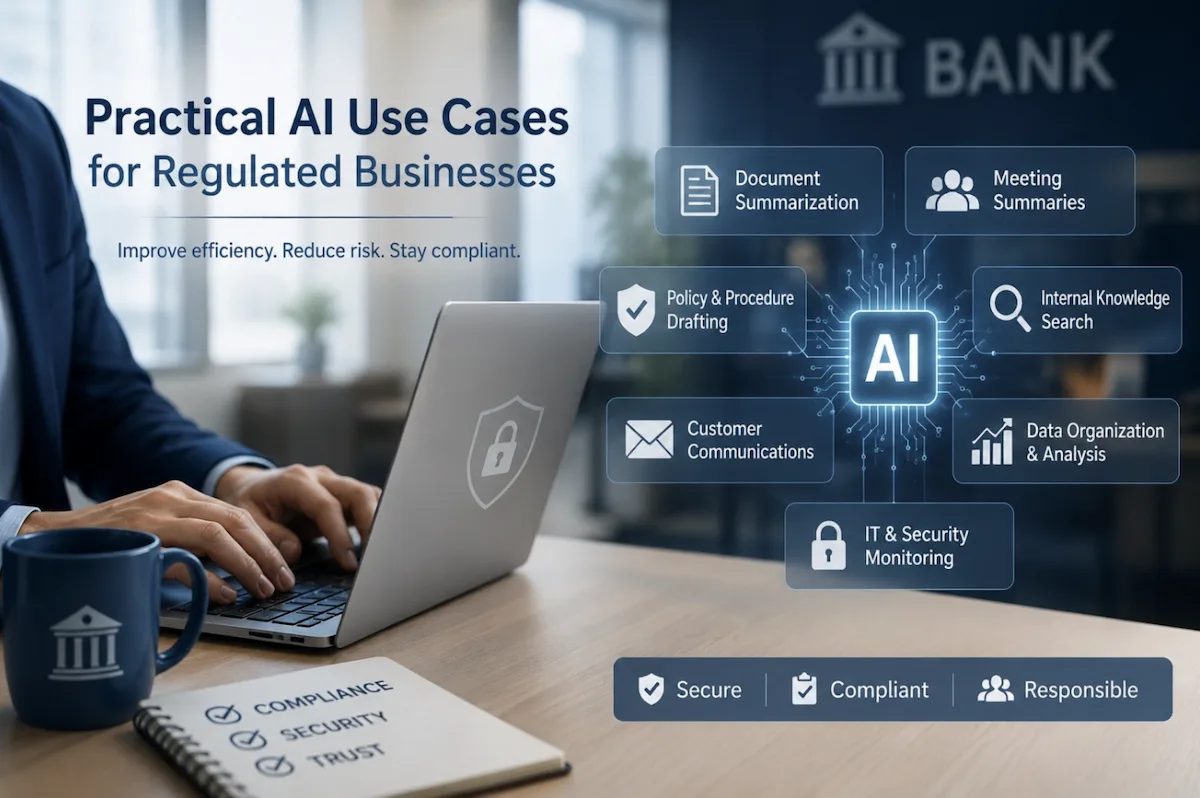
AI Use Cases That Actually Make Sense for Regulated Businesses
Artificial Intelligence has quickly gone from a future-looking technology discussion to an everyday workplace reality.
Employees are already experimenting with tools like ChatGPT, Microsoft Copilot, AI meeting assistants, and AI-powered search platforms—often without formal approval from leadership or IT. In many organizations, AI adoption is happening quietly in the background while policies, governance, and security reviews struggle to keep pace.
For community banks, credit unions, healthcare organizations, and other regulated businesses, this creates an uncomfortable challenge.
There is real pressure to improve efficiency and reduce operational strain. But there is also a very real need to protect sensitive data, maintain compliance, and reduce organizational risk.
The question is no longer whether AI has business value.
The real question is where AI makes sense for regulated organizations—and how businesses can adopt it responsibly.
Why Regulated Businesses Are Approaching AI Carefully
Unlike startups or marketing agencies that can rapidly experiment with new tools, regulated organizations operate under a completely different level of scrutiny.
Banks and credit unions must protect financial data while maintaining compliance with evolving regulatory requirements. Healthcare organizations face strict privacy obligations tied to patient information. Even small organizations are expected to maintain strong cybersecurity controls, documentation standards, and vendor oversight.
That means AI adoption cannot simply be treated like downloading another productivity app.
One of the biggest concerns organizations face is data exposure. Employees may unknowingly paste confidential information into public AI platforms without realizing how that data is stored, processed, or retained. Something as simple as summarizing customer information, uploading financial reports, or asking an AI tool to analyze internal documentation can unintentionally create compliance and security concerns.
This is one reason regulated businesses are increasingly focusing on layered security and stronger oversight before expanding AI usage. Organizations already dealing with growing cybersecurity threats understand that visibility and control matter more than ever. Our article on Why Cybersecurity Matters for Small and Regulated Businesses explains why proactive risk management has become essential for organizations handling sensitive data.
Another challenge is accountability.
If an AI-generated recommendation is inaccurate, incomplete, or misleading, who is responsible for verifying it? In regulated industries, leadership teams still own the outcome—even when AI tools are involved.
That’s why the most successful organizations are approaching AI strategically instead of treating it like a shortcut.
The Best Early AI Use Cases for Regulated Organizations
The most effective AI implementations are not replacing entire departments or fully automating critical decisions.
Instead, organizations are finding value in targeted, low risk use cases that improve efficiency while keeping humans involved in oversight and validation.
One of the most practical starting points is administrative workload reduction.
Many organizations spend enormous amounts of time drafting policies, summarizing meetings, organizing notes, or creating internal communications. AI tools can dramatically reduce the time required for those repetitive tasks.
For example, an internal IT team might use AI to summarize lengthy support tickets before escalation. A compliance officer may use AI to organize regulatory guidance into a simpler first draft for review. Healthcare administrators may use AI-powered meeting transcription tools to capture action items more efficiently.
The key difference is that employees still review and validate the output before it becomes final.
This “human-in-the-loop” approach allows businesses to improve productivity without handing decision-making entirely to AI systems.
Another growing use case is internal knowledge management.
Many organizations struggle with scattered documentation, inconsistent processes, and institutional knowledge that lives in email inboxes or employee memory. AI-powered search and documentation tools can help staff quickly locate internal procedures, policies, or troubleshooting guidance.
This becomes especially valuable for lean IT departments already managing significant workloads. As discussed in How Managed IT Supports Compliance Without Overloading Your Internal Team, many organizations are already balancing compliance responsibilities with limited internal bandwidth.
Cybersecurity operations are also becoming increasingly AI-assisted.
Modern security platforms now use AI to identify unusual behavior, prioritize alerts, and reduce false positives that overwhelm security teams. Managed Detection and Response (MDR) platforms increasingly rely on AI to accelerate threat detection and incident response, helping organizations react faster to suspicious activity. This aligns closely with the importance of proactive monitoring and layered protection strategies already discussed in Layers of Security.
Importantly, these tools are not eliminating security professionals.
They help teams process information faster in environments where response speed matters.
Which AI Tools Actually Make Sense?
One mistake organizations often make is focusing too heavily on individual AI products instead of evaluating whether a platform aligns with security, compliance, and operational requirements.
In regulated environments, the “best” AI tool is rarely the newest or most popular one.
It is the one that supports:
- Secure data handling
- User access controls
- Audit visibility
- Vendor accountability
- Integration with existing systems
- Administrative oversight
For many organizations, enterprise-grade AI platforms tied to existing business ecosystems are becoming the safest starting point.
Microsoft Copilot, for example, has gained traction because it integrates with Microsoft 365 environments many organizations already use. This allows businesses to apply existing identity management, security controls, and compliance policies more consistently.
AI-enabled cybersecurity tools are also becoming increasingly valuable.
Security teams are using AI-assisted monitoring to analyze alerts, identify patterns, and detect suspicious behavior faster than traditional manual review alone. This becomes particularly important as cybercriminals themselves begin using AI to create more convincing phishing attacks and social engineering campaigns.
Organizations should also evaluate vendors carefully before deployment.
Questions leadership teams should ask include:
- Where is organizational data stored?
- Is customer information used to train public models?
- What logging and audit capabilities exist?
- How are permissions managed?
- What happens if the vendor experiences a breach?
- Are compliance certifications available?
These conversations are increasingly overlapping with broader IT governance and risk management discussions. Our article on What Regulators and Auditors Expect from Your IT outlines why documentation, monitoring, and oversight continue to play such a critical role in regulated industries.
Where Organizations Begin to Create Risk
The largest AI risks often do not come from official IT projects.
They come from unmanaged employee behavior.
This is commonly referred to as “shadow AI” — when employees independently adopt AI tools without organizational approval, oversight, or security review.
A staff member may use a public AI chatbot to summarize customer information. Another employee may upload internal financial data into a free AI platform to speed up reporting. Someone else may rely on AI-generated compliance guidance without verifying accuracy.
None of these actions may be malicious.
But all of them can create operational, compliance, and security exposure.
Another growing concern is overreliance on AI-generated content.
AI tools can produce responses that sound highly confident even when the information is inaccurate or entirely fabricated. In regulated environments, relying on unchecked AI outputs can lead to reporting errors, policy mistakes, inaccurate communications, or compliance problems.
This is why organizations cannot treat AI as a replacement for oversight.
AI should support employees—not eliminate human accountability.
The organizations seeing the most success with AI today are the ones implementing boundaries early.
They are defining approved use cases.
They are evaluating vendors carefully.
They are creating policies.
They are educating employees.
And most importantly, they are treating AI adoption as part of a larger cybersecurity and governance strategy.
AI Adoption Should Start Small and Intentionally
There is no question that AI will continue reshaping how organizations operate.
The productivity gains are real. The operational efficiencies are meaningful. And for already stretched teams, AI can help reduce repetitive work and improve responsiveness.
But regulated organizations cannot afford uncontrolled adoption.
The businesses that benefit most from AI over the next several years will not necessarily be the fastest adopters.
They will be the organizations that implement AI thoughtfully, securely, and strategically.
That starts with identifying practical use cases, evaluating risk, establishing clear policies, and ensuring employees understand both the opportunities and the limitations of AI tools.
Just as cybersecurity evolved from an IT issue into a business-wide responsibility, AI is quickly becoming a governance and risk management conversation.
Organizations that approach it with visibility, oversight, and intentional planning will be far better positioned to benefit from AI without creating unnecessary exposure.
As AI adoption accelerates, businesses need more than new tools—they need clear strategies, oversight, and trusted guidance.
0 Comments