
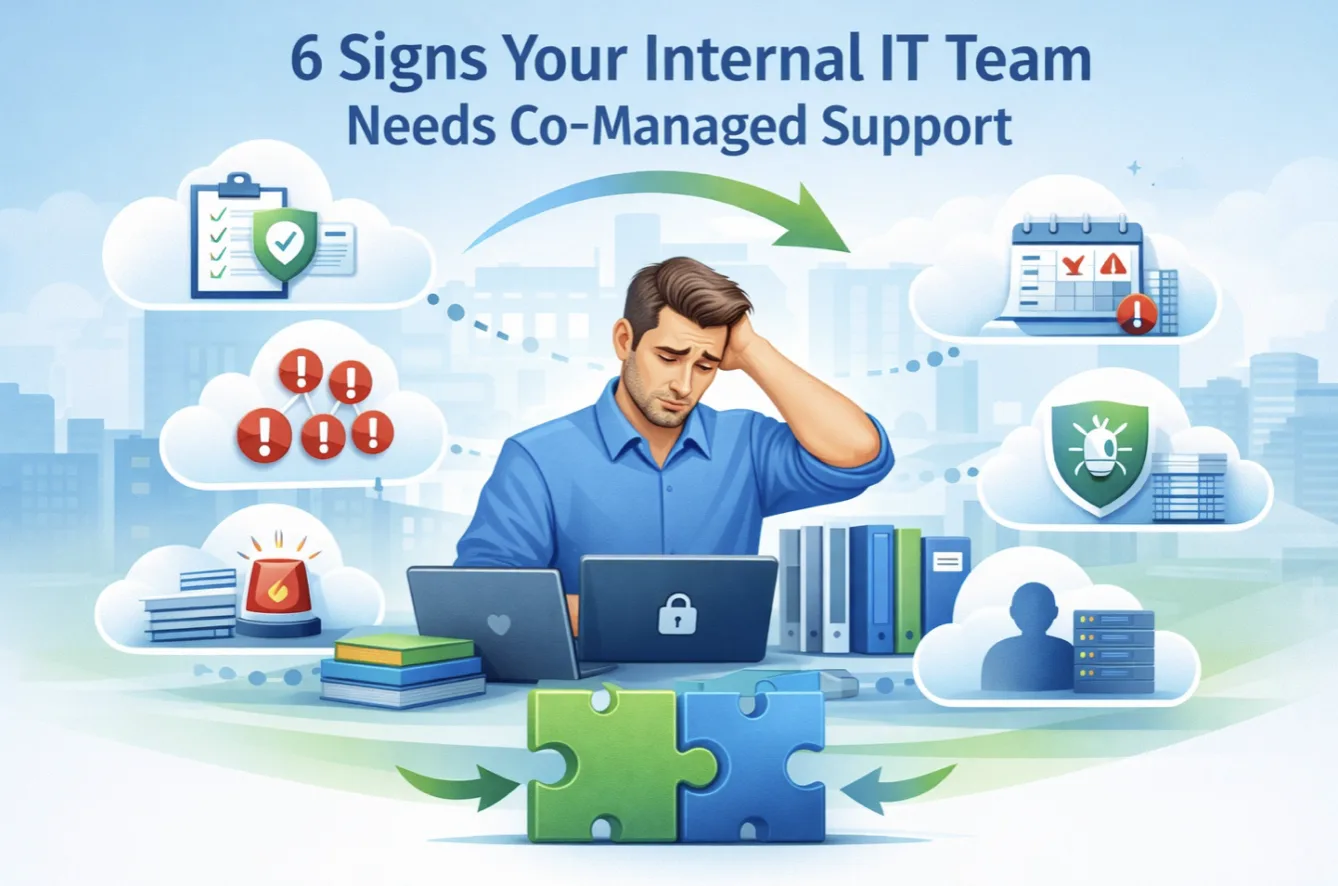
They invest in capable internal staff. They build institutional knowledge. They value control.
But over time, something shifts.
Compliance requirements increase. Cyber threats become more sophisticated. Audits demand more documentation. Leadership expects strategic technology planning — not just troubleshooting.
And suddenly, the internal IT team that once felt sufficient is stretched thin.
If you’re wondering whether your team needs additional support — but you’re not ready to fully outsource IT — here are six clear signs that co-managed IT may be the right next step.
Sign #1: Compliance Work Is Crowding Out Strategic IT Initiatives
In regulated industries, compliance is no longer occasional — it’s continuous.
Internal IT teams are now responsible for:
- Monitoring and reviewing security alerts
- Documenting patching and updates
- Supporting risk assessments
- Preparing for audits and exams
- Maintaining evidence of controls
These responsibilities build on what we discussed in March’s post on what regulators and auditors expect from your IT.
The result? Strategic projects get delayed.
System upgrades, modernization efforts, and infrastructure improvements are pushed aside because compliance tasks consume available time.
If your IT roadmap keeps slipping due to audit preparation and documentation demands, that’s a strong indicator your team needs support.
Is compliance work slowing down your IT progress?
Sign #2: Security Alerts Are Overwhelming Your Team
Modern cybersecurity tools generate alerts constantly.
Without dedicated monitoring, internal teams may:
- Miss critical warnings
- Delay response times
- Experience alert fatigue
- Focus only on the most obvious issues
This directly connects to the layered security model we covered in January’s blog on what layered security actually means.
Security monitoring isn’t a part-time responsibility anymore — it’s a continuous process.
If your internal IT staff is reviewing alerts between help desk tickets and project work, the risk of something slipping through increases significantly.
Co-managed IT provides structured, consistent monitoring support without removing internal oversight.
Sign #3: One Person Holds Too Much Institutional Knowledge
In many regulated organizations, a single IT manager or senior technician becomes the central hub of all knowledge.
While that individual may be highly capable, this creates:
- A single point of failure
- Limited coverage during vacations or illness
- Risk during staff turnover
- Bottlenecks for decision-making
If your IT environment relies heavily on one person’s memory rather than documented processes, that’s a vulnerability.
This is especially concerning given the documentation expectations discussed in our March post on IT documentation as a compliance cornerstone.
Co-managed IT distributes knowledge and ensures systems, processes, and documentation are shared — not isolated.
Sign #4: Audit Preparation Feels Like a Fire Drill
Audits should not feel like emergencies.
If your organization experiences:
- Last-minute documentation gathering
- Scrambling to produce reports
- Uncertainty about patching records
- Stress around backup verification
…it’s a sign your processes are reactive instead of continuous.
This often happens in environments that evolved from break-fix IT — a model we explored in February’s blog on 7 signs your business has outgrown break-fix support.
Co-managed IT helps maintain documentation and monitoring consistently so audits become smoother and less disruptive.
Want audits to feel predictable instead of stressful?
Sign #5: Cyber Risk Assessments Identify Gaps You Can’t Quickly Address
Risk assessments — now expected in most regulated industries — often uncover vulnerabilities.
But identifying risk is only part of the equation.
The bigger question becomes:
Who is going to fix it?
If your team lacks:
- Bandwidth to address findings
- Specialized cybersecurity expertise
- Time to track mitigation progress
Risk remains documented but unresolved.
This is exactly why we emphasized in March that risk assessments are no longer optional — they must connect to action.
Co-managed IT ensures findings aren’t just documented — they’re systematically addressed.
Sign #6: Your IT Team Is Showing Signs of Burnout
Burnout doesn’t always look dramatic.
It can look like:
- Delayed responses
- Increasing frustration
- Avoided long-term planning
- Declining morale
Internal IT teams in regulated organizations often carry enormous responsibility:
- Protecting sensitive data
- Maintaining uptime
- Ensuring compliance
- Supporting users
- Planning future improvements
Without support, even strong teams can become overwhelmed.
Co-managed IT doesn’t replace internal staff — it protects them.
Real-World Example
A credit union with fewer than 100 employees relied on a two-person internal IT team.
As regulatory expectations increased, documentation, monitoring, and compliance reporting began consuming most of their time. Strategic improvements stalled, and audit cycles became stressful.
After implementing a co-managed model:
- 24/7 monitoring shifted to the external partner
- Patch management became standardized
- Documentation stayed current
- Internal IT regained time for infrastructure improvements
The team retained control — but gained capacity.
Why Leadership Should Pay Attention to These Signs
From a leadership perspective, the risk isn’t just technical — it’s operational.
Overloaded IT teams increase the likelihood of:
- Missed security incidents
- Audit findings
- Downtime
- Staff turnover
Co-managed IT is not an admission of weakness. It’s a strategic decision to strengthen your internal capabilities.
Frequently Asked Questions
Does co-managed IT mean we’re outsourcing our IT department?
Is co-managed IT only for larger organizations?
Can we customize what we outsource and what we retain?
Will this increase our IT budget significantly?
Final Thought
Internal IT teams in regulated organizations are being asked to carry more responsibility than ever before.
If compliance is crowding out strategy, security alerts feel overwhelming, and audits create stress instead of structure, it may be time to expand your team — without replacing it.
Co-managed IT provides the balance:
- Control without overload
- Expertise without headcount expansion
- Support without disruption
0 Comments