
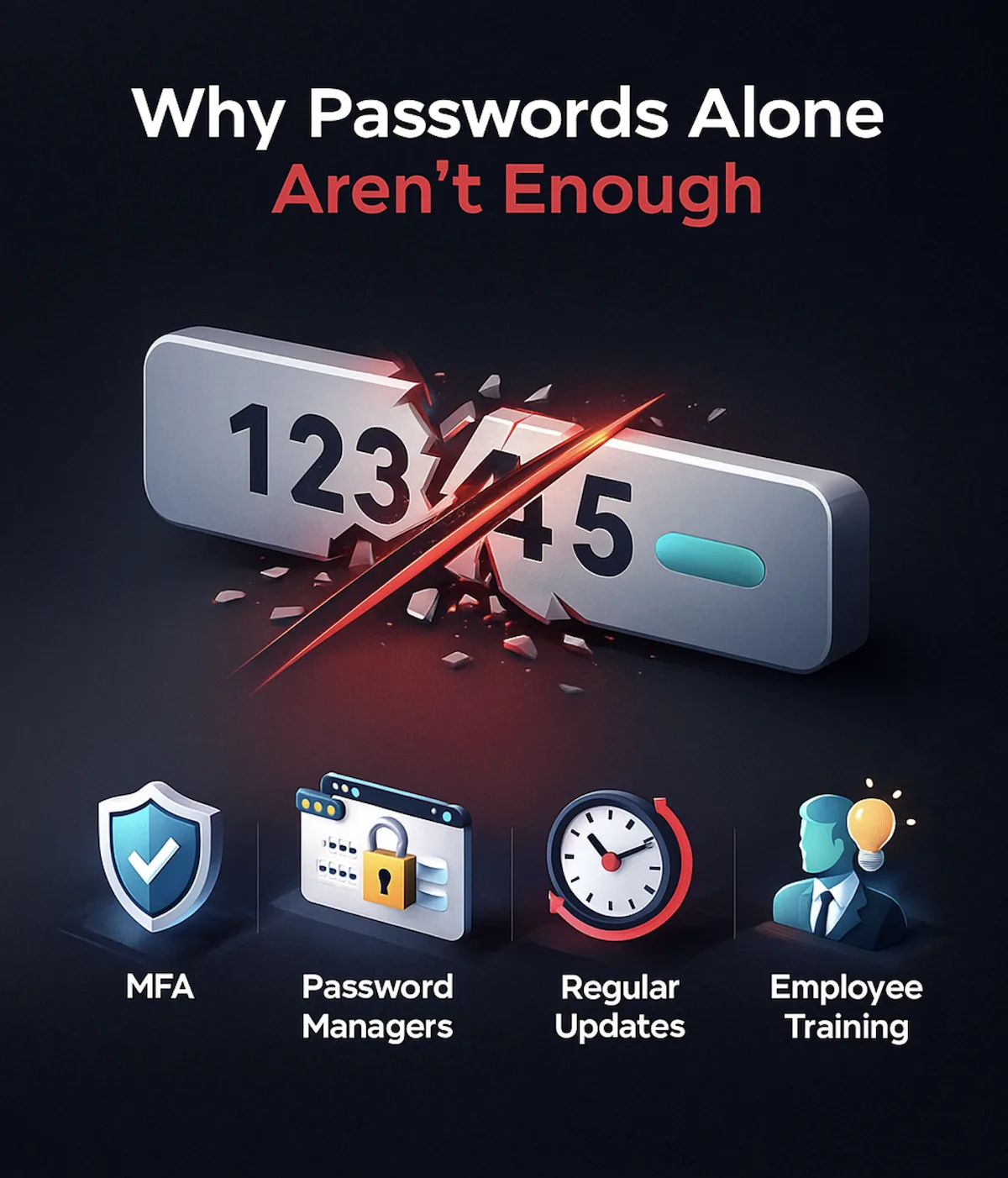
Cybercriminals use advanced tools that can crack even complex passwords in minutes. Worse, many breaches today don’t involve guessing at all—they involve stealing credentials through phishing or dark-web leaks.
Let’s break it down clearly.
The Problems with Passwords
Problem #1 — People reuse passwords
Once one site is breached, attackers try the same password everywhere.
Problem #2 — Passwords get stolen
Phishing emails are getting harder to detect, and one click can compromise everything.
Problem #3 — Attackers use automation
They can try millions of password combinations in seconds.
Problem #4 — “Strong” passwords still fail without MFA
A strong password without MFA is like having a steel door with no deadbolt.
What You Need Instead
✔ 1. Multi-Factor Authentication (MFA)
This is your second lock.
Even if attackers steal the password, they can’t get in.
✔ 2. Password Managers
These generate and store strong, unique passwords so employees don’t reuse simple ones.
✔ 3. Regular Password Updates
Especially for:
- Banking systems
- Remote access
- Admin accounts
✔ 4. Employee training
Most breaches start with someone being tricked.
Training reduces that risk dramatically.
This Is Now Required by Regulators & Cyber Insurers
Banks, credit unions, and healthcare organizations must use MFA and password best practices to stay compliant and maintain cyber insurance coverage.
Carriers often deny claims when MFA isn’t in place.
Final Thought
You don’t need to be technical to strengthen your security—small changes like implementing MFA and a password manager can prevent catastrophic breaches.
We can help you get these protections in place fast.
0 Comments