
They recognize the risks posed by cyberattacks, downtime, compliance requirements, and increasing technology complexity. They understand the need for monitoring, recovery planning, documentation, testing, and ongoing risk management.
The challenge isn’t understanding what needs to be done.
The challenge is finding the time, expertise, and resources to do it consistently.
For many organizations, especially community banks, credit unions, healthcare providers, and other regulated businesses, internal IT teams are already stretched thin. They are supporting users, managing projects, troubleshooting issues, responding to security concerns, maintaining infrastructure, and addressing compliance requests—often with limited staff and growing expectations.
As operational demands continue to increase, many organizations are discovering that resilience is no longer a technology challenge.
It’s a capacity challenge.
The Growing Gap Between Responsibilities and Resources
Today’s IT departments are responsible for far more than keeping systems operational.
They are expected to manage cybersecurity, oversee cloud platforms, support remote work, maintain compliance documentation, coordinate vendors, respond to incidents, perform risk assessments, and help drive strategic initiatives.
At the same time, staffing challenges continue to affect organizations across nearly every industry.
Hiring experienced cybersecurity professionals is difficult.
Finding specialists in compliance, cloud infrastructure, and business continuity is even harder.
For smaller and mid-sized organizations, building an internal team with expertise across all these areas is often financially unrealistic.
As a result, many IT departments find themselves trapped in a cycle of constant reaction.
Urgent issues consume attention while strategic initiatives are delayed.
Projects move forward, but documentation falls behind.
Security tools are deployed, but monitoring becomes inconsistent.
Recovery plans exist, but testing rarely occurs.
None of these situations result from poor effort. They are usually the consequence of limited capacity.
Operational Resilience Requires Consistency
One of the most important lessons organizations learn is that resilience is not built through a single project.
It is built through consistent execution over time.
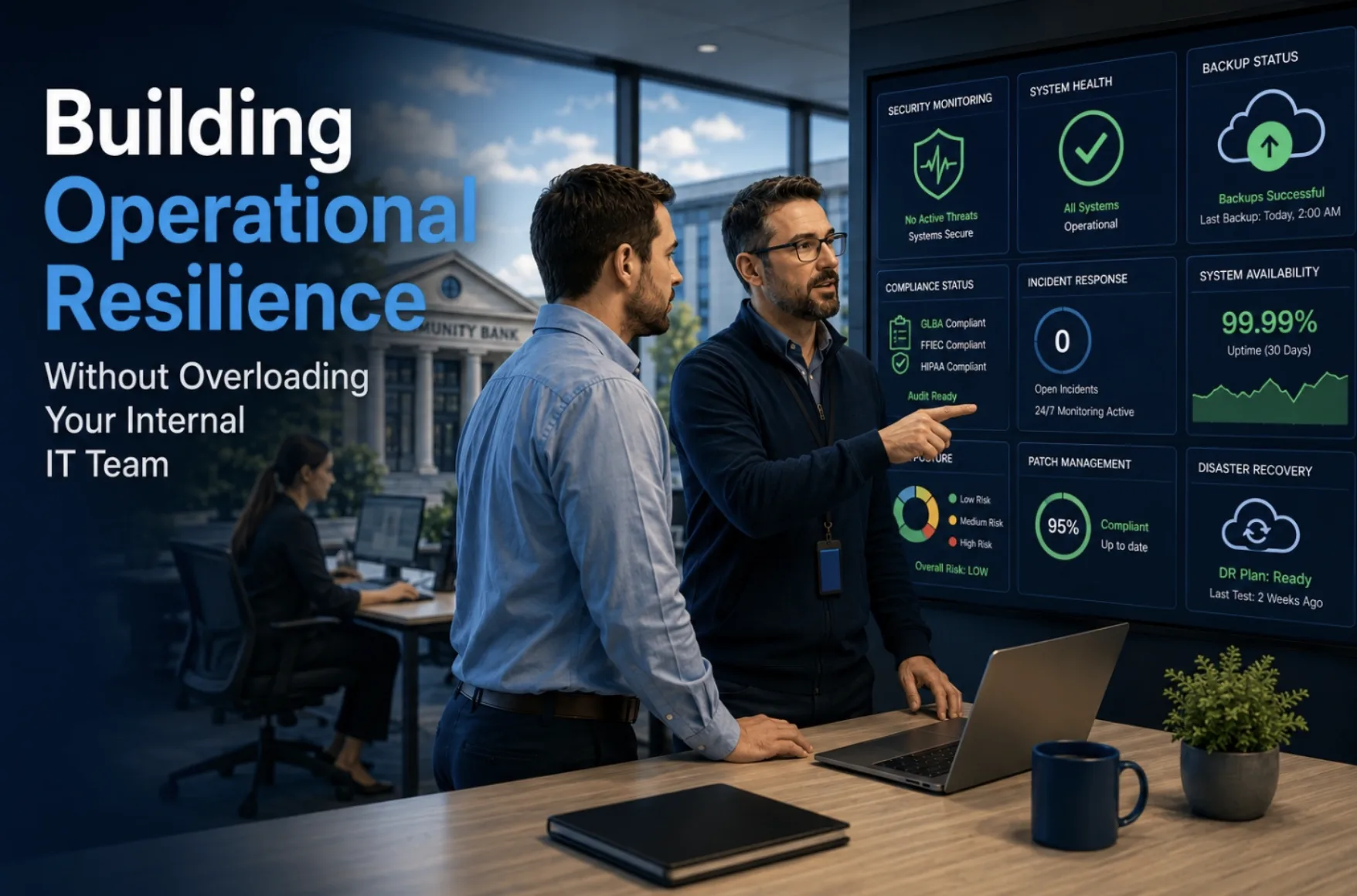
Backups must be monitored.
Patches must be applied.
Security alerts must be reviewed.
Documentation must be updated.
Recovery plans must be tested.
Risk assessments must be revisited.
These activities may not always feel urgent, but they become critically important during a disruption.
The organizations that recover most effectively are rarely the ones that implemented the most technology.
They are the ones that maintained operational discipline long before an incident occurred.
As discussed in our article Cybersecurity Tools Aren’t the Problem — The Gaps Around Them Are, many organizations already possess capable security and infrastructure solutions. The challenge often lies in maintaining the operational processes required to support them.
Operational resilience depends on consistency, and consistency requires capacity.
The Capacity vs. Capability Challenge
Many organizations assume resilience gaps exist because they lack technical expertise.
In reality, the problem is often capacity rather than capability.
Internal IT professionals frequently know exactly what needs to be done.
They understand the importance of patch management.
They recognize the need for recovery testing.
They know documentation should be updated.
They are aware of compliance expectations.
The problem is finding enough hours in the day to accomplish everything.
This distinction is important because it changes how organizations approach resilience planning.
The answer is not always hiring more employees.
In many cases, organizations need additional support, specialized expertise, and operational bandwidth rather than additional management layers.
Recognizing this difference allows leaders to focus on sustainable solutions rather than simply increasing headcount.
Why Co-Managed IT Is Gaining Momentum
As operational requirements continue to grow, many organizations are turning to co-managed IT models.
Unlike traditional outsourcing, co-managed IT is designed to strengthen internal IT teams rather than replace them.
Internal staff continue leading strategy, business alignment, and organizational priorities.
External experts provide additional resources, specialized knowledge, monitoring, security operations, and operational support.
This approach helps organizations address critical resilience activities that often fall behind due to resource constraints.
For example, a co-managed partner may assist with:
- 24/7 monitoring and threat response
- Patch and vulnerability management
- Backup and disaster recovery oversight
- Compliance support and documentation
- Infrastructure modernization projects
- Helpdesk escalation and technical expertise
This allows internal teams to focus on strategic initiatives while maintaining the operational consistency required for resilience.
As we discussed in Co-Managed IT Services: A Smarter Solution for Overstretched IT Teams, the goal is not replacement. The goal is reinforcement.
Resilience Requires More Than Technology
One of the biggest misconceptions about operational resilience is that purchasing new technology automatically improves preparedness.
Technology certainly plays a critical role.
However, resilience ultimately depends on people, processes, and execution.
A monitoring platform provides little value if alerts are never reviewed.
A backup system provides limited protection if recovery procedures are never tested.
A security solution cannot compensate for outdated documentation or unclear responsibilities.
Organizations that achieve the highest levels of resilience understand this distinction.
They focus on creating repeatable processes, clear accountability, and consistent operational practices.
Technology supports those efforts, but it cannot replace them.
This is why operational resilience should always be viewed as a business discipline rather than a technology initiative.
Building a Sustainable Resilience Strategy
The most resilient organizations rarely attempt to solve every challenge at once.
Instead, they focus on creating sustainable, repeatable improvements over time.
This often begins by identifying the areas that create the greatest operational risk.
Questions leadership teams should consider include:
- Are critical systems continuously monitored?
- How confident are we in our recovery capabilities?
- When was our disaster recovery plan last tested?
- Do we have sufficient documentation to support audits and recovery efforts?
- Are cybersecurity responsibilities clearly defined?
- Does our IT team have the capacity to manage growing demands?
The answers help organizations prioritize investments that strengthen resilience without overwhelming internal resources.
The objective is not perfection.
The objective is creating an environment where critical services can continue despite disruption.
Operational Resilience Is a Team Effort
Perhaps the most important realization for leadership teams is that operational resilience is not the responsibility of a single department.
IT plays a critical role.
Security teams play a critical role.
Compliance teams play a critical role.
Leadership plays a critical role.
Building resilience requires alignment across the organization.
It requires clear priorities, realistic expectations, and ongoing support for the people responsible for maintaining critical operations.
Organizations that treat resilience as a shared responsibility are often far better equipped to adapt when challenges arise.
Final Thoughts
Operational resilience has become one of the defining business priorities for modern organizations.
Yet achieving resilience does not require building a massive internal IT department or hiring specialists for every discipline.
What it does require is consistency.
Monitoring systems consistently.
Managing risk consistently.
Testing recovery plans consistently.
Supporting employees consistently.
Improving processes consistently.
For many organizations, the most effective path forward is not doing more with the same resources.
It is strengthening internal capabilities with the right expertise, support, and operational partnership.
Because resilience is not built through isolated projects.
It is built through sustained execution.
And sustained execution is much easier when your team does not have to carry the entire burden alone.
0 Comments