
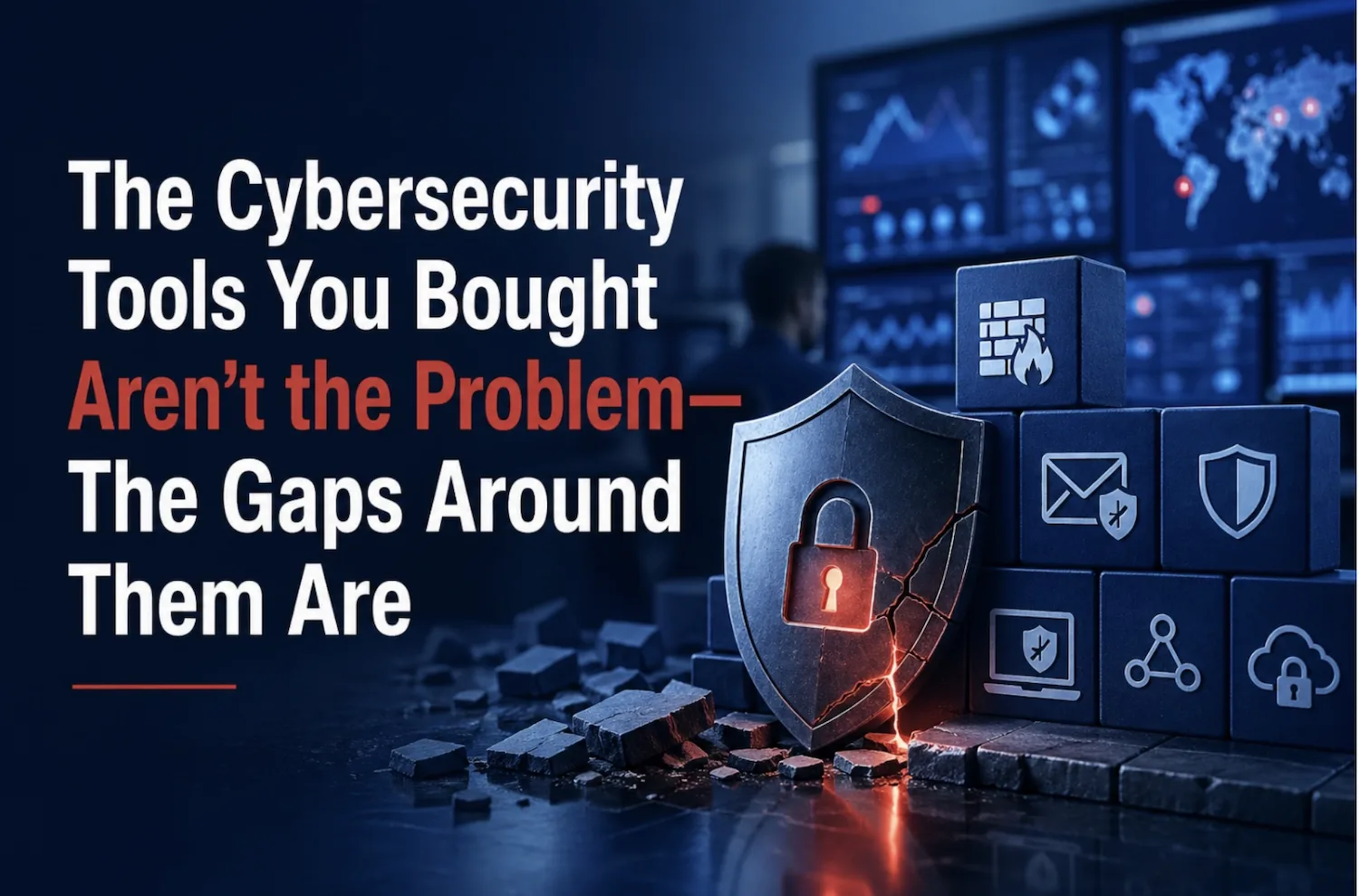
When “Fully Secured” Isn’t Actually Secure
There’s a moment that catches a lot of leadership teams off guard.
An incident happens—a compromised account, a ransomware attempt, suspicious activity inside the network—and the immediate reaction is confusion.
Because on paper, everything was in place.
The organization had invested in endpoint protection. Email filtering was active. Firewalls were configured. Policies existed. The right boxes were checked.
And yet, something still got through.
That disconnect is where most cybersecurity conversations need to shift.
Because in regulated industries, the issue is rarely a lack of tools.
It’s what’s happening—or not happening—around them.
The Core Problem: Security Without Execution
Cybersecurity tools are often treated like safeguards you install once and rely on indefinitely.
But that’s not how they function in practice.
Every security control—no matter how advanced—depends on ongoing execution. It needs to be monitored, maintained, reviewed, and acted on. Without that, it becomes passive.
And passive security doesn’t stop active threats.
This is part of the reason organizations that appear well-protected still fall victim to attacks. As outlined in this blog post, attackers aren’t looking for organizations without defenses. They’re looking for organizations where defenses aren’t consistently enforced.
That’s a much easier target.
Where the Gaps Quietly Develop
The most dangerous cybersecurity gaps don’t look dramatic. They don’t show up as obvious failures or missing tools.
They build slowly, in the background, as environments evolve and processes fall out of sync.
Take monitoring, for example.
Most security tools generate alerts constantly—some meaningful, many not. Over time, internal teams begin to prioritize what they can realistically keep up with. Alerts get reviewed during business hours. Lower-priority warnings get deferred. Noise becomes normalized.
Then one alert—the one that matters—sits just a little too long.
That delay is often all an attacker needs.
A similar pattern happens with configuration.
Security tools are deployed with best intentions, often configured correctly at the start. But environments don’t stay static. Users change roles. systems are added. exceptions are made. Over time, those small adjustments create drift.
No single change creates risk on its own. But collectively, they create exposure that no one has fully visibility into.
This is where many organizations begin to realize that cybersecurity isn’t failing because of a single breakdown. It’s failing because no one is continuously validating that everything is still working the way it should.
The Illusion of Layered Security
Most organizations understand the concept of layered security.
They’ve invested in multiple controls—endpoint protection, firewalls, email filtering, backups—each designed to address a different type of threat.
But layering only works if those controls operate as a coordinated system.
Many environments function more like a collection of independent tools. Each one does its job in isolation, but there’s no unified oversight ensuring they work together.
That creates gaps between the layers.
An email filter might flag a suspicious message, but if the user still interacts with it and endpoint protections aren’t fully aligned, the threat moves forward. If monitoring isn’t immediate, the response is delayed. If access controls are too broad, the impact spreads further than expected.
This is why the concept of defense-in-depth requires active management—not just implementation.
Without coordination, layers create a false sense of security rather than real protection.
A Scenario That Plays Out More Often Than It Should
Consider a financial institution with a mature-looking security stack.
A phishing email bypasses filtering—not because the tool failed entirely, but because the message was crafted just well enough to avoid detection.
An employee clicks the link and unknowingly enters credentials.
At this point, multiple safeguards should limit the damage.
But the account doesn’t have multi-factor authentication enforced everywhere. Monitoring tools generate a login anomaly alert, but it isn’t reviewed immediately. The attacker gains access, moves laterally, and begins collecting data.
By the time the activity is identified, the situation has escalated well beyond a simple phishing incident.
What’s important here is that no single control “failed” outright.
Instead, small gaps aligned:
- Partial enforcement of MFA
- Delayed alert response
- Excessive access permissions
Individually manageable. Together, they created a breach.
This is exactly how most modern attacks succeed—and why they’re difficult to prevent with tools alone.
Why This Becomes a Compliance Issue—Not Just a Security One
In regulated environments, the consequences don’t stop at the incident.
After a breach, regulators don’t just ask what happened. They ask how the organization was managing its controls.
Was monitoring continuous? Were alerts reviewed and acted on in a timely manner? Were access controls appropriate and enforced consistently?
If the answer to those questions is unclear—or unsupported by documentation—the issue expands beyond cybersecurity.
It becomes a governance problem.
And that’s where organizations face findings, increased scrutiny, and potential penalties.
The difference between a contained incident and a reportable compliance issue often comes down to process—not technology.
The Shift That Needs to Happen
Organizations that reduce cyber risk don’t approach security as a collection of tools.
They treat it as an operational discipline.
That means shifting focus from what has been purchased to how it is being managed every day.
Monitoring isn’t occasional—it’s continuous. Response isn’t delayed—it’s immediate and structured. Configurations aren’t assumed—they’re reviewed and validated. Users aren’t left to figure things out—they’re trained and reinforced over time.
This is also where many organizations begin to adopt more advanced support models—because maintaining that level of consistency internally is difficult without dedicated resources.
Reducing detection and response time is one of the most effective ways to limit the impact of modern threats. But that only happens when monitoring and response are actively managed—not passively expected.
The Takeaway
Cybersecurity failures are rarely dramatic breakdowns.
They’re the result of small, manageable gaps that go unaddressed long enough to matter.
The tools you’ve invested in are important—but they’re only one part of the equation.
What determines your actual level of protection is everything that surrounds them:
- How consistently they’re monitored.
- How quickly issues are addressed.
- How well controls are enforced across the environment.
Because attackers aren’t trying to outmatch your technology.
They’re looking for the places where it isn’t fully working.
And in today’s environment, that’s more than enough.
0 Comments