
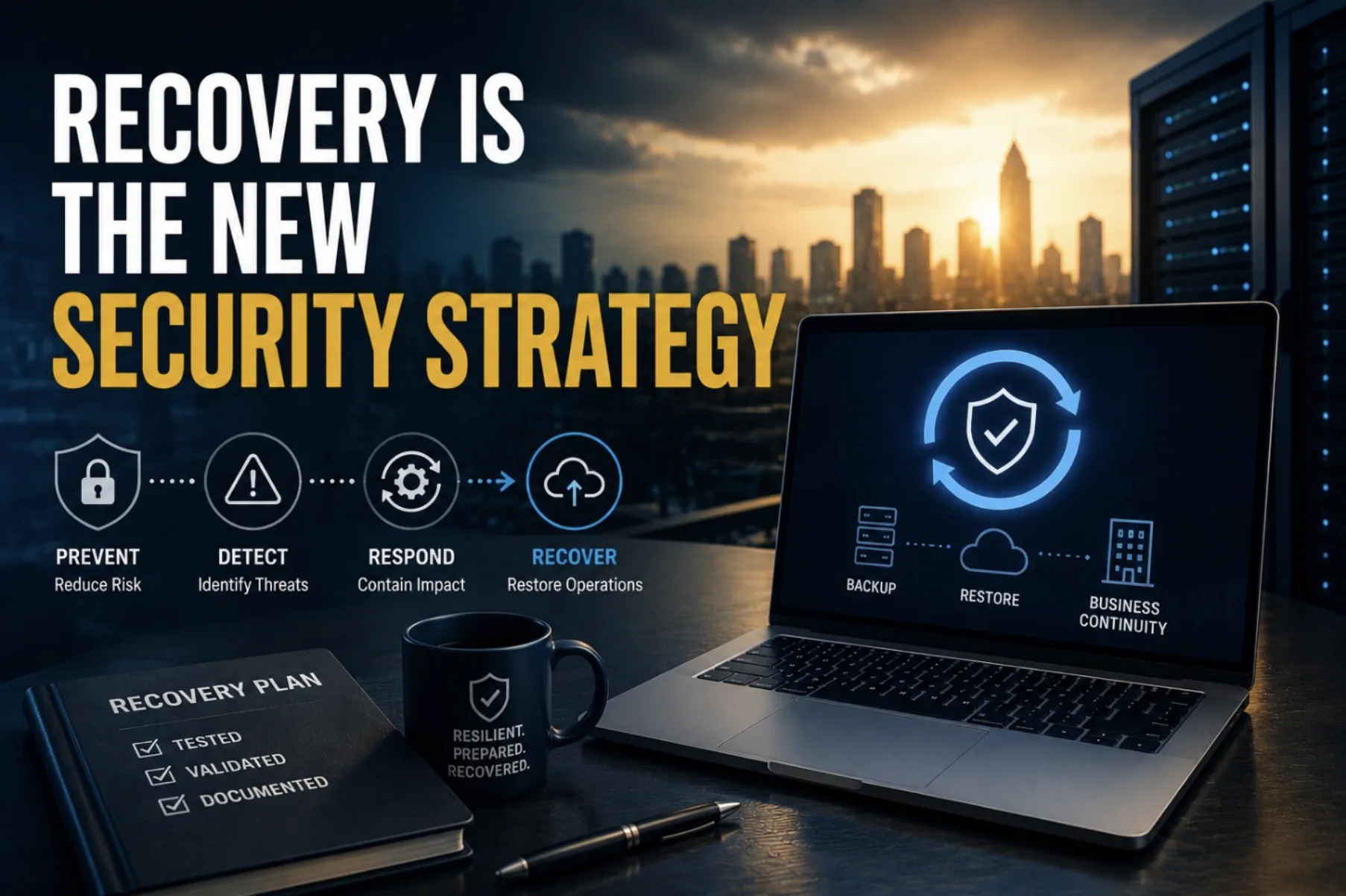
Organizations invested in firewalls, antivirus software, email filtering, endpoint protection, and employee training. The goal was straightforward: keep threats out and prevent incidents from occurring.
Those investments remain important. Every organization should continue strengthening its preventive security controls.
But today’s threat landscape has exposed an uncomfortable reality.
No security strategy can guarantee that every attack will be stopped.
Even organizations with mature cybersecurity programs experience ransomware attacks, cloud outages, vendor disruptions, hardware failures, human error, and other unexpected events. In many cases, the difference between a minor disruption and a major business crisis has less to do with prevention and more to do with recovery.
That is why recovery has become one of the most important components of operational resilience.
The question is no longer, “Can we prevent every incident?”
The question is, “How quickly can we recover when something goes wrong?”
Prevention Is Essential—but It Isn’t Enough
Most business leaders understand the importance of cybersecurity.
They invest in tools designed to reduce risk, monitor threats, and protect sensitive information. These controls are critical and should never be overlooked.
However, cybersecurity professionals increasingly recognize that modern security requires a different mindset.
Attackers only need to succeed once.
Organizations must succeed every day.
Even with strong security controls in place, incidents can still occur. A sophisticated phishing email may bypass filters. A trusted vendor may experience a breach. A system administrator may accidentally misconfigure a critical service. A cloud provider may suffer an outage.
These situations are not always the result of negligence. They are often the reality of operating in a highly connected digital environment.
As discussed in our article on Layers of Security, effective protection requires multiple safeguards working together. Recovery capabilities represent one of the most important layers because they help organizations continue operating even when preventive controls fail.
Why Recovery Has Become a Business Priority
Historically, backup systems were viewed as insurance policies.
Organizations performed backups because auditors expected them or because it seemed like a best practice. Unfortunately, many businesses never tested whether those backups could actually restore operations.
That approach is becoming increasingly dangerous.
Today’s organizations rely on technology to support nearly every critical business function. When systems become unavailable, the impact is immediate.
Employees cannot work.
Customers cannot access services.
Transactions cannot be processed.
Communications become difficult.
Leadership teams face pressure to provide answers.
For regulated organizations, the consequences can extend even further. Downtime may trigger compliance concerns, customer trust issues, and increased scrutiny from regulators and auditors.
The longer recovery takes, the greater the business impact becomes.
This shift has transformed disaster recovery from an IT project into a business priority.
Backups Don’t Guarantee Recovery
One of the most common misconceptions organizations have is believing that successful backups automatically mean successful recovery.
Unfortunately, that assumption often proves costly.
A backup is simply a copy of data.
Recovery is the ability to restore systems, applications, and operations within an acceptable timeframe.
There is a significant difference between the two.
Consider an organization that backs up its servers every night. On paper, everything appears protected.
However, if restoring those systems takes three days, the business may still experience significant disruption.
Customers may be unable to access services.
Employees may be unable to perform their jobs.
Revenue-generating activities may come to a halt.
Compliance obligations may become difficult to meet.
The backup worked exactly as designed. The recovery strategy did not.
This is why operationally resilient organizations focus on recovery outcomes rather than backup completion reports.
The Questions Leadership Teams Should Be Asking
Many executives assume disaster recovery is a technical topic best left to IT departments.
In reality, recovery readiness directly impacts business performance and leadership accountability.
Boards and executive teams should understand the answers to several critical questions:
- How long can our organization operate without critical systems?
- What is our expected recovery time after a disruption?
- When was our disaster recovery plan last tested?
- Which business functions would be affected first?
- Are backups protected from ransomware attacks?
- How confident are we in our ability to restore operations?
These questions often reveal gaps that organizations did not realize existed.
In many cases, leaders discover they have backup systems but no documented recovery procedures. Others learn that testing occurs infrequently or that recovery timelines are significantly longer than expected.
The most resilient organizations continuously evaluate these risks before a disruption occurs.
Why Testing Matters More Than Technology
A recovery plan that has never been tested is simply a theory.
This is one of the most overlooked challenges in business continuity planning.
Organizations frequently invest in backup platforms and disaster recovery technologies but fail to validate whether recovery processes actually work under real-world conditions.
Testing serves several important purposes.
First, it verifies that backups can be restored successfully.
Second, it identifies gaps in documentation and procedures.
Third, it helps employees understand their responsibilities during an incident.
Finally, it provides leadership with confidence that recovery objectives are realistic and achievable.
Organizations are often surprised by what they discover during recovery testing.
Missing documentation, outdated contact information, failed backup jobs, application dependencies, and recovery delays are common findings.
Finding these issues during a planned test is far preferable to discovering them during a real emergency.
Ransomware Changed the Recovery Conversation
Few events have influenced disaster recovery planning more than ransomware.
Modern ransomware attacks are no longer limited to encrypting production systems. Attackers increasingly target backup environments as well.
Their goal is simple: eliminate recovery options and increase pressure to pay.
This is why many organizations are implementing additional safeguards such as immutable backups, offline storage, and air-gapped recovery environments.
These approaches help ensure recovery data remains available even if production systems are compromised.
As we explored in Cybersecurity Tools Aren’t the Problem — The Gaps Around Them Are, resilience depends not only on having the right technology but also on managing and validating it consistently.
Recovery capabilities must be treated as active components of a cybersecurity strategy rather than passive insurance policies.
Recovery Is the Foundation of Operational Resilience
Operational resilience is ultimately about maintaining critical business services despite disruption.
Recovery is what makes that possible.
Organizations cannot eliminate every risk.
They cannot prevent every outage.
They cannot stop every attack.
What they can do is build the capability to recover quickly, restore operations efficiently, and minimize business impact when disruptions occur.
That capability creates confidence for leadership, customers, regulators, and employees alike.
In today’s environment, resilience is no longer measured solely by how well an organization prevents incidents.
It is increasingly measured by how effectively it recovers from them.
Final Thoughts
Cybersecurity will always begin with prevention.
But operational resilience requires something more.
Organizations must assume that disruptions will occur and prepare accordingly.
The most successful organizations are not those that never experience problems. They are the ones that recover quickly, maintain customer trust, and continue delivering critical services despite adversity.
Recovery is no longer just a disaster recovery objective.
It is a business strategy.
And increasingly, it is one of the most important security investments an organization can make.
0 Comments