
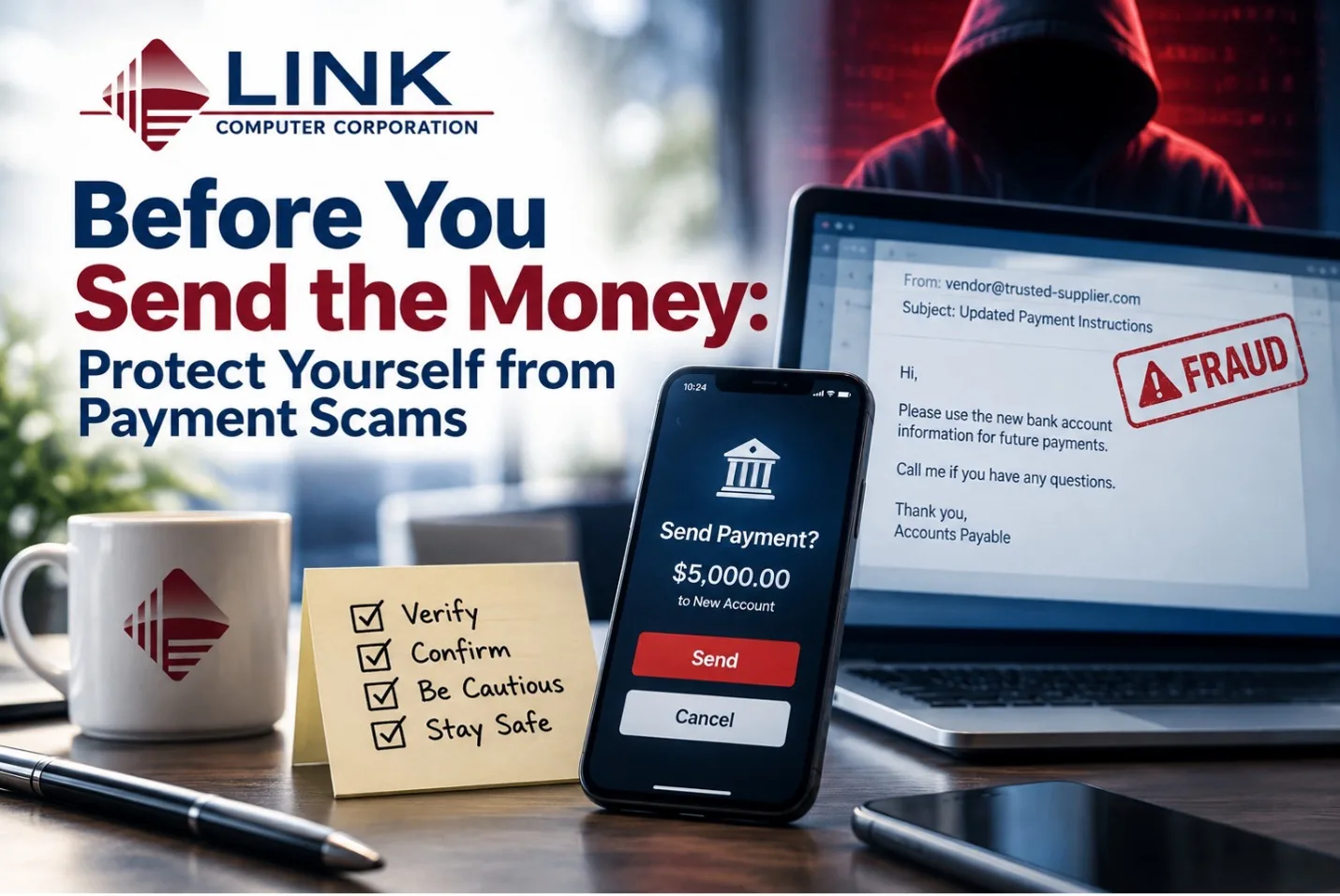
The message looks legitimate.
A vendor sends updated payment instructions. A family member texts saying they need money right away. Someone purchasing an item from you online asks you to use a particular payment method. Or perhaps a person claiming to represent your bank says money needs to be moved to keep it safe.
In each situation, there is usually a reason to act quickly.
That is exactly why you should slow down.
Payment scams come in many forms, but they often depend on the same basic strategy: convince you to send money before you have time to verify who is really asking for it.
A Familiar Request Can Still Be Fraudulent
Some scams are easy to recognize. Others are surprisingly convincing.
Criminals may impersonate businesses, financial institutions, coworkers, executives, vendors, friends, or family members. They may contact you by email, telephone, text message, or social media.
In some cases, the criminal may already know enough about you or the organization you work with to make the request sound believable.
Imagine receiving an email from a vendor you regularly pay. The message says the company recently changed banks and provides new instructions for your next payment.
Everything looks normal.
Except the message didn’t come from the vendor.
A criminal may have gained access to an email account, created a similar-looking email address, or gathered enough information to imitate the company. If the new instructions aren’t independently verified, the next payment could go directly to the criminal.
The same principle applies in your personal life. A familiar name or convincing story doesn’t prove that a request is legitimate.
Urgency Should Trigger Verification
Scammers don’t want you to have time to think.
They may tell you a payment is overdue, an account is at risk, a family member is in trouble, or an opportunity will disappear unless you act immediately.
Urgency changes how people make decisions.
When a request involves sending money, changing payment information, or providing financial details, treat pressure as a reason to verify rather than a reason to hurry.
If a vendor unexpectedly changes payment instructions, call a trusted contact at that company using a telephone number you already have.
If a family member sends an unusual request for money, call them directly.
If someone claiming to represent your bank tells you to move money to another account for protection, end the conversation and contact your bank directly using a trusted telephone number.
A legitimate request will survive a few minutes of verification.
Be Especially Careful When Payment Instructions Change
For businesses, one of the most important warning signs is an unexpected change involving money.
An employee might receive what appears to be an email from a supplier announcing new banking information. Someone in accounting may receive an urgent request that appears to come from an executive. Payroll may be contacted about changing an employee’s direct-deposit information.
These requests deserve additional scrutiny because criminals understand normal business processes and may try to insert themselves into them.
Organizations can reduce this risk by establishing clear procedures for financial changes. For example, employees can be required to independently verify new payment instructions with a known contact before making the change.
The process doesn’t need to be complicated. It simply needs to prevent one email, text, or telephone call from being enough to redirect money.
Be Cautious When Someone Tells You How to Pay
The requested method of payment can also be a warning sign.
Be especially cautious when someone unexpectedly insists that you send money immediately or tells you that there is only one acceptable way to pay.
The story may be elaborate. The request itself is often simple: send the money now.
Before doing so, ask yourself a few questions.
Do I know this person? Was I expecting this request? Does the situation make sense? Can I verify it independently?
If anything feels unusual, stop the transaction until you have answers.
Your Bank Will Never Be Offended That You Verified
Scammers often succeed because people worry about seeming suspicious, difficult, or impolite.
Protecting your money is none of those things.
If someone calls claiming to represent your bank and you aren’t certain who you’re speaking with, you can end the call and contact the bank yourself.
Use the telephone number printed on your bank card, listed on your statement, or published through the bank’s official website. Don’t simply call a number provided in the suspicious message.
The same habit works beyond banking. Whenever money or sensitive financial information is involved, independently verifying the request gives you another opportunity to identify something that doesn’t add up.
If You Think You Sent Money to a Scammer, Act Quickly
Sometimes people recognize a scam only after a payment has been made.
If that happens, don’t wait.
Contact your financial institution or payment provider as soon as possible. Explain what happened and ask what steps may be available. Depending on the type of transaction and circumstances, there may be actions that can be taken, although recovery is not always possible.
If the incident happened at work, report it immediately through your organization’s established process as well.
Speed matters. So does accuracy. Provide as much information as you can about the transaction and the communication that led to it.
Make Verification Part of Every Important Transaction
Technology will continue to change, and scams will change with it. The safest habits are the ones that work regardless of how a criminal contacts you.
Slow down when someone creates urgency.
Question unexpected changes to payment instructions.
Use contact information you already trust to confirm unusual requests.
And never let someone pressure you into sending money before you are comfortable that you know where it is going.
You don’t need to recognize every type of payment scam.
You need to recognize the moment when verification matters.
0 Comments